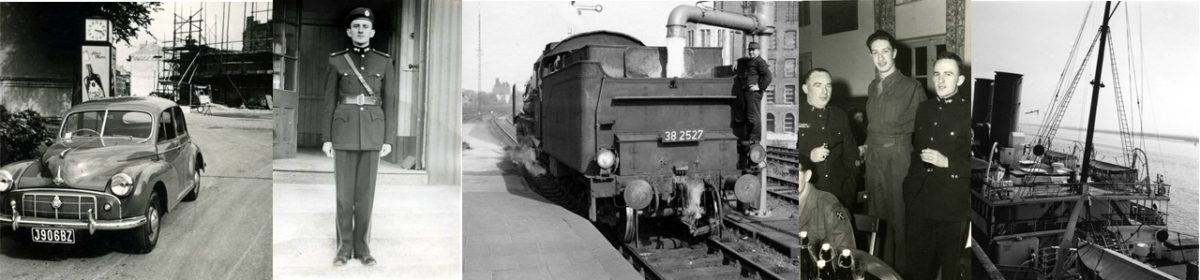
In early October I caught the train from Paddington to Malvern. I met my new companions at Malvern Station, where we were collected by a number of Bedford four wheel drive T.C.V.s (Troop Carrying Vehicles). Malvern was a hutted camp consisting of a number of single storey cement block structures, comprising sleeping accommodation, kitchens, mess buildings and stores, all connected by covered walkways.
We were kitted out with uniforms, boots, shirts, underwear, nightclothes, webbing and other equipment. We were given brown paper and string to parcel our civilian clothes and send them home. We were issued bedding, including blankets, sheets and pillows, together with the ubiquitous green lightweight, a fine woolen blanket used to cover the bed, chiefly for decorative purposes. Our basic uniform comprised khaki battledress blouse and trousers with boots, webbing belt and gaiters, black lanyard, jackknife and supporting cord, with khaki shirt and tie and dark blue beret. Additionally we were given hairy undergarments, socks, pyjamas, P.T. kit, greatcoat, etc., etc.
In the next few days we were inoculated – sitting astride benches in rows, while a medical orderly went down each side with a hypodermic, jabbing each man as he passed.
We were now Sappers, albeit amateur ones. We were initiated into the basic military rites; bullshit, obedience, cleanliness, survival. We quickly learned not to hold our china mugs in the arm that swung when walking to the cookhouse – the covered ways leading there were supported on concrete posts which allowed no carelessness.
After two weeks of rapid conversion into some sort of soldiery, we were allowed out of camp at the weekend to be reminded of how life had changed; I stayed behind.
The beret had to be shrunk for smartness, and then brushed either with a boot blacking brush or brass bristle brush to remove any suggestion of dust. All badges and buckles had to have casting imperfections removed and given a mirror finish using metal polish and cardboard. Boots were converted to appear like patent leather, by using Kiwi polish applied with a spoon heated over a lighted candle. The effect was ruined the first time one paraded by the soldiers behind and ahead.
MORVAL
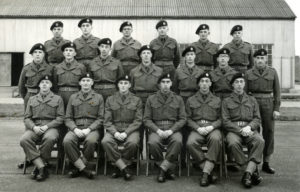
Our next posting was Farnborough. This was a second home for the Royal Engineers, who had trained here on the outskirts of Aldershot since the days before the Royal Aircraft Establishment. Morval barracks was part of the Southminster camp, the other part known as Guillemont , both named after French First World War battles. The wooden buildings were known as ‘spiders’ – they comprised a central nucleus of ablutions and six parallel legs of accommodation huts, the whole layout taking the form of a giant insect. Away from these lay the parade ground, covered drill area, cookhouse, mess and administrative offices. Plenty of whitened stone edgings – “If it moves, salute it, if it doesn’t, whitewash it.” Grassed areas were frequently trimmed with jackknives, which resulted in a similar shorn appearance to the weekly shilling haircut. Whitewashing stacks of coal was an effective method of discouraging stealing from them.
The two corporals in charge of our troop at Morval barracks were called Ogden and Allen. The former had, I believe, worked in a saw mill, the latter on a construction site. Oggie was a hard taskmaster and generally unpleasant, Allen less so. They played the typical roles of the bad and good policemen. Towards the end of our training we appreciated the skill with which Oggie would manoeuvre our troop towards the refreshments van at the appropriate time, although this was presumably as much as, or more than, in his interest as ours.
“Bullshit baffles brains” The archetypal army truism. Our introduction to this ideal was contained in the instructions for keeping our room clean; “You are not allowed to add bleach to the water in the fire bucket, and applying boot polish to the pump hose is forbidden. However, this is the only way in which these items can be kept in good order.”
If cleanliness and Godliness are related as closely as was suggested, the Sappers must have been among the holiest of soldiers. Corporal Ogden would climb to the summit of the internal roof structure to check whether there was dust on the rubber insulated electric cabling, and the second lieutenant who occasionally inspected our hut once decided to beat our bed packs (the carefully contrived, permanent displays of sheets and blankets that represented what were supposed to be daily layouts) with his bamboo swagger stick, with predictable clouds of dust ensuing, and fatigues following.
If walking around camp with another soldier, both had to keep in step; naturally each had to salute if passing an officer, and in unison. (up, two three, down two three.)
At Morval we quickly settled to real training. Firstly we were indoctrinated into soldierly, and particularly Sapper, ways. To be soldierly you had to avoid athlete’s foot and venereal disease. The former appeared to be both more preventable and serious, so much so that several of us tried to obtain treatment for it before we were invalided out of the army altogether. Needless to say, it was not easy, as any attempt to report sick was made extraordinarily difficult; it entailed dressing up in one’s best uniform in full kit (webbing belt, pouches, and other equipment), and reporting to the guard room (regimental police with white webbing and a complete absence of any sense of humour, or justice or common sense, for that matter).
We were taught the Sapper song, which described the activities of two bygone second lieutenants or warrant officers (Mr Stevens and Mr Knight) and finished with a South African chorus of politically incorrect and unrepeatable tastelessness. The regimental march to which we were also introduced was an agreeable, possibly German, piece of music.
Denim overalls were used for all training activities, and, as smartness involved wearing baggy trousers over ones gaiters and boots, the laundry returns were fiercely competed for, and taller Sappers were often forced to wear calf length trousers.
We spent several weeks training in basic Sapper functions. The word “Sapper” derives from the name of the trenches or ‘Saps’ employed since medieval times to undermine enemy fortifications, and our training included trench digging in sandy ground that had been previously well excavated. This meant that the sides of any new trench quickly collapsed, doubling or tripling the effort needed. It was the only time in my life I used a wooden wheelbarrow, and as with much of the basic army plant, the effort required to operate it ensured a good appetite afterwards. Our food was excellent, much better than boarding school. It was supplemented by mobile canteens run by the Salvation Army (Sally Ann’s) and others, who supplied us with tea and doughnuts on the training grounds.
We were instructed in firearms; the Lee Enfield rifle, survivor of the First and Second World Wars, and the Bren gun, a semi automatic gun designed in Brno (Czechoslovakia) and made in Enfield.
Our camp was situated in a wooded area (fieldcraft) and adjacent to Hurley Lake (water based activity). We were given instruction in the use of pontoons driven by inboard motors.
One one kit cleaning occasion, I was in the cleaning room to hear Jim Pinnock describing his girl to his assembled friends. He obviously knew her much better than I did from the few times I had met her. I still puzzle how I recognized her, as I am sure he did not give her name.
At Morval, we were segregated into ordinary soldiers (‘other ranks’) and potential officer cadets (O.R.1s) who, as their title suggests, were to be given the opportunity of climbing the greasy pole of promotion. At the end of our basic sapper training, we were posted for a few weeks to Guillemont barracks to become involved in various informal schemes, initiative tests and exercises. These involved map reading skills, night manoeuvres and endurance marches. On one occasion a night exercise was cancelled and we were left with six pounds of uncooked sausages which we had hoped to barbecue. We managed to cook them in our hut the next day by using an (unregulated) electric clothes iron positioned upside down between two large steel kit boxes; the sausages were then fried in our aluminium mess tins. Neutralizing the cooking smell afterwards was difficult.
Returning from the exercise one night we were as usual singing in the back of the t.c.v. The side curtains were rolled up and the thirty or so voices made a good mobile choir. Unfortunately the song chosen was “The ball of Kirremuir” a rugby dissertation on the fate of a team of virgins who hailed from Inverness. Oggie panicked that the residents of Haselmere might not be prepared to discover the sequel, and in an instant this was changed to “Silent Night” with hardly a pause.
During a threatened national dockworkers strike, it looked likely that we would have to provide army transport to move freight, but this never materialised. Our first Christmas, for which we were all given leave, was celebrated beforehand with a party in the canteen. The cooks did us really well, and until, and even after, someone poured a pint of beer over the regimental sergeant major’s head, goodwill reigned throughout.
The potential officers were sent to the Selection Board at Barton Stacey. Here they were tested to destruction. “They check to see how you hold your knife and fork”.
We were given command tasks (how to lead a group over an assault course) lecture skills were tested (a five minute talk on “the bicycle”) and – most difficult of all, a ramped scaffold board set at a steep angle, which you had to run at fast enough to carry you to the top, five or six feet above ground. For me, this was a true test; on the one hand I could see it was clearly impossible, on the other I could see that failure would be a disaster. In the event, I reached the top more or less on my knees and fell over the edge, luckily landing on my feet.
Barton Stacey must have been one of the coldest places on earth the night we stayed there. I lodged with a member of the H.L.I. (Highland Light Infantry), who retailed gruesome tales about the Glasgow criminals with whom he was billetted. The only item I remember was the mirror he described on the floor of the guardroom which ensured that no soldier could exit wearing underpants beneath his kilt.