Foreword: the love-sick trainee who signed up

1952:  I am nineteen.

I am a trainee quantity surveyor on holiday with my parents in Mevagissey, and I have just met the prettiest and most attractive girl that I will ever encounter.

I had experienced eleven years of boarding school, starting before my seventh birthday. I attended three schools; Forest School in Walthamstow, Carn Brea, first at Cranleigh, and then at Bromley, and then Bradfield in Berkshire. The teaching throughout was variable; it was wartime, and many capable teachers had joined the forces, but I eventually mastered most of the subjects I studied. I won a small grant – a mini scholarship – to my secondary school, and thereafter prospered at latin, maths and chemistry.

Father would have liked me to have gone on to university – I attended an interview at Cambridge where I was told that they were not prepared to consider me until I had done my two years of National Service. I was not keen on the idea in any case, and as I wanted to enter the family building business, I was lucky enough to secure an apprenticeship in the surveying office of a moderate sized building contractor in Stratford, East London, A.E. Symes Ltd. For this I obtained a deferred call up to my National Service.

A few weeks after leaving school, I was employed on a building site in Poplar, where I was treated with great kindness, if with some reservation; it was after all, a social upheaval for me and I was an object of curiosity for my new companions in the class conscious attitudes of the times. I found myself with blistered hands assisting the bricklayers, carpenters and plumbers; I was sent out to fetch rolls of felt, fixings and sky hooks, the latter a favourite leg pull in the industry.

The site was part of the 1951 Festival of Britain; the general foreman was Bill MacMonnies, a former bricklayer from Liverpool, a true gentleman, who kept tropical fish and seemed to find these more rewarding than his wife. They had no family of their own, and when I last heard of him, he had found work in the Virgin Islands where he was said to have gone with a female companion.

One of his men was a ganger, in charge of the labourers. He was an interesting character; he had enlisted in the army during the First World War aged fifteen or sixteen, and been sent to fight in France, where he admitted to killing the enemy without compunction; it was after all, what he had signed on for.

He was particularly proud of his summary execution of a tramp around 1930. On this occasion he had accompanied his sister, her husband and their two small daughters on a picnic on a river bank in Kent. After their lunch, the children wandered off, returning in tears because one of the girls had been attacked by a strange man. He and his brother in law set out to look for this person, and came upon a tramp whom they suspected might be the offender. They interrogated the man, who strenuously denied responsibility, and as they did not believe him, they threw him into the nearby river. When he swam ashore, he and his brother in law questioned him again. Again he denied responsibility, so they threw him in again. This continued until he admitted the offence, after which they threw him back and made sure he didn’t come out. To him this represented justice; he had spent his war service executing Germans who had done no wrong in his eyes, and he was now able to execute a man who was manifestly guilty, and to do so with the minimum of trouble and expense.

In the early summer of 1951, I was moved into Symes’ offices and started to learn to be a quantity surveyor; at the same time I attended part time day and evening classes, and even won a prize for being the second best building student in the London Region. In the summer of 1952 I was sent up to Warrington, where my employers were building a factory extension and enlarging the existing electricity generating plant for Thames Board Mills, a Unilever subsidiary.

I lodged in Stockton Heath, on the banks of the Mersey Ship Canal, at that time a busy waterway. My landlady was Mrs Ward, a dour and humourless Lancashire divorcee. I asked my fellow lodger who the man was who came every Thursday evening to watch television with Mrs Ward. Tom Dunbar replied that he was surprised that I didn’t know that he was Mrs Ward’s erstwhile husband.

At the beginning of August I left Warrington, and returned to the London office. I had not really enjoyed my spell in Lancashire, and asked not to go back, a request which was accepted. I then went on holiday with my parents and brothers to Mevagissey, where I met the girl who I immediately decided was the love of my life.

Unfortunately the life then became more complicated, as my new friend came from Cheshire, a formidable distance from where I lived, in London. At the start, I managed to obtain an invitation to the Warrington office Christmas party, and was able to call to see my friend in Knutsford, en route. Luckily the visit was a success, and emboldened by this, I forced myself to ask the chief surveyor, Harry Jones, for Saturday morning off; we normally worked until twelve on Saturdays. Harry Jones looked over the top of his glasses: “You can have it this time, but don’t let it become a habit, Fuller.” “No sir, of course not sir, thank you very much sir.” Well, not for another three weeks, anyway. Luckily I was able to borrow the family’s second car – an Austin A40 estate, or adapted van, and in the following spring I asked if I could return to Warrington, only a dozen miles from Knutsford, for another few weeks of training. Again I was lucky, and – apart from my friend’s occasional wish to terminate matters, all went well.

So life blossomed; every three weeks or so I drove North; no mean feat in the days before motorways, with a car with a top speed of little over 60 mph, poor roads and heavy goods traffic travelling in convoy at official maximum speeds of 20 mph.

In the spring of 1954, my friend’s parents invited me to go on holiday with them to Mevagissey again, and this time disaster struck. We all went, of course; the weather was cold and dull, and it was intended that my friend should come back to London afterwards and spend a week sightseeing. Alas, she decided that she had had enough. I was forced to return home on my own and it spelled the end of what I felt had been the time of my life. Although I made a number of attempts to revive matters, they all ended in failure. I became such a dreary individual that my exasperated parents eventually suggested that I should join my cousin, whose building career was parallel to my own, and do my National Service, albeit a year earlier than originally intended. In the event, this was what happened, and I duly had my medical (“Drop your trousers, cough, fair enough.”).

Before I started, I was invited to the wedding of a local friend, where I met a girl, (“The only trouble is, she is very similar to the other one,” said mother) whom I invited out two or three times. The last time we went out, I took her home to Welwyn Garden City where she lived. I was introduced to her parents who questioned me on my background and training. I explained that I was a trainee surveyor but expected to finish my apprenticeship and start my National Service in two weeks time. “What branch of the Services will you be joining?” asked the father. I explained that I was due to enlist in the Royal Engineers at Malvern. “Isn’t that where Jim is going?” he asked his daughter, to which she shrugged a non committal response. As this was the first mention I had had of Jim, I was mildly curious, but no more than that, and in fact I soon forgot about him – and her.
Part one: creating a clean and tidy Sapper

In early October I caught the train from Paddington to Malvern. I met my new companions at Malvern Station, where we were collected by a number of Bedford four wheel drive T.C.V.s (Troop Carrying Vehicles). Malvern was a hutted camp consisting of a number of single storey cement block structures, comprising sleeping accommodation, kitchens, mess buildings and stores, all connected by covered walkways.

We were kitted out with uniforms, boots, shirts, underwear, nightclothes, webbing and other equipment. We were given brown paper and string to parcel our civilian clothes and send them home. We were issued bedding, including blankets, sheets and pillows, together with the ubiquitous green lightweight, a fine woolen blanket used to cover the bed, chiefly for decorative purposes. Our basic uniform comprised khaki battledress blouse and trousers with boots, webbing belt and gaiters, black lanyard, jackknife and supporting cord, with khaki shirt and tie and dark blue beret. Additionally we were given hairy undergarments, socks, pyjamas, P.T. kit, greatcoat, etc., etc.

In the next few days we were inoculated – sitting astride benches in rows, while a medical orderly went down each side with a hypodermic, jabbing each man as he passed.

We were now Sappers, albeit amateur ones. We were initiated into the basic military rites; bullshit, obedience, cleanliness, survival. We quickly learned not to hold our china mugs in the arm that swung when walking to the cookhouse – the covered ways leading there were supported on concrete posts which allowed no carelessness.

After two weeks of rapid conversion into some sort of soldiery, we were allowed out of camp at the weekend to be reminded of how life had changed; I stayed behind.

The beret had to be shrunk for smartness, and then brushed either with a boot blacking brush or brass bristle brush to remove any suggestion of dust. All badges and buckles had to have casting imperfections removed and given a mirror finish using metal polish and cardboard. Boots were converted to appear like patent leather, by using Kiwi polish applied with a spoon heated over a lighted candle. The effect was ruined the first time one paraded by the soldiers behind and ahead.

MORVAL

f14
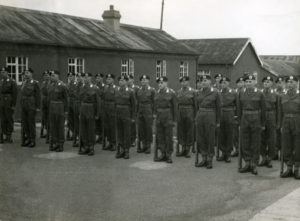
Cadets from Royal Engineers training regiment at Morval barracks towards the end of 1954. Fuller in middle row, second from left

Our next posting was Farnborough. This was a second home for the Royal Engineers, who had trained here on the outskirts of Aldershot since the days before the Royal Aircraft Establishment. Morval barracks was part of the Southminster camp, the other part known as Guillemont , both named after French First World War battles. The wooden buildings were known as ‘spiders’ – they comprised a central nucleus of ablutions and six parallel legs of accommodation huts, the whole layout taking the form of a giant insect. Away from these lay the parade ground, covered drill area, cookhouse, mess and administrative offices. Plenty of whitened stone edgings – “If it moves, salute it, if it doesn’t, whitewash it.” Grassed areas were frequently trimmed with jackknives, which resulted in a similar shorn appearance to the weekly shilling haircut. Whitewashing stacks of coal was an effective method of discouraging stealing from them.

The two corporals in charge of our troop at Morval barracks were called Ogden and Allen. The former had, I believe, worked in a saw mill, the latter on a construction site. Oggie was a hard taskmaster and generally unpleasant, Allen less so. They played the typical roles of the bad and good policemen. Towards the end of our training we appreciated the skill with which Oggie would manoeuvre our troop towards the refreshments van at the appropriate time, although this was presumably as much as, or more than, in his interest as ours.

“Bullshit baffles brains” The archetypal army truism. Our introduction to this ideal was contained in the instructions for keeping our room clean; “You are not allowed to add bleach to the water in the fire bucket, and applying boot polish to the pump hose is forbidden. However, this is the only way in which these items can be kept in good order.”

If cleanliness and Godliness are related as closely as was suggested, the Sappers must have been among the holiest of soldiers. Corporal Ogden would climb to the summit of the internal roof structure to check whether there was dust on the rubber insulated electric cabling, and the second lieutenant who occasionally inspected our hut once decided to beat our bed packs (the carefully contrived, permanent displays of sheets and blankets that represented what were supposed to be daily layouts) with his bamboo swagger stick, with predictable clouds of dust ensuing, and fatigues following.

If walking around camp with another soldier, both had to keep in step; naturally each had to salute if passing an officer, and in unison. (up, two three, down two three.)

At Morval we quickly settled to real training. Firstly we were indoctrinated into soldierly, and particularly Sapper, ways. To be soldierly you had to avoid athlete’s foot and venereal disease. The former appeared to be both more preventable and serious, so much so that several of us tried to obtain treatment for it before we were invalided out of the army altogether. Needless to say, it was not easy, as any attempt to report sick was made extraordinarily difficult; it entailed dressing up in one’s best uniform in full kit (webbing belt, pouches, and other equipment), and reporting to the guard room (regimental police with white webbing and a complete absence of any sense of humour, or justice or common sense, for that matter).

We were taught the Sapper song, which described the activities of two bygone second lieutenants or warrant officers (Mr Stevens and Mr Knight) and finished with a South African chorus of politically incorrect and unrepeatable tastelessness. The regimental march to which we were also introduced was an agreeable, possibly German, piece of music.

Denim overalls were used for all training activities, and, as smartness involved wearing baggy trousers over ones gaiters and boots, the laundry returns were fiercely competed for, and taller Sappers were often forced to wear calf length trousers.

We spent several weeks training in basic Sapper functions. The word “Sapper” derives from the name of the trenches or ‘Saps’ employed since medieval times to undermine enemy fortifications, and our training included trench digging in sandy ground that had been previously well excavated. This meant that the sides of any new trench quickly collapsed, doubling or tripling the effort needed. It was the only time in my life I used a wooden wheelbarrow, and as with much of the basic army plant, the effort required to operate it ensured a good appetite afterwards. Our food was excellent, much better than boarding school. It was supplemented by mobile canteens run by the Salvation Army (Sally Ann’s) and others, who supplied us with tea and doughnuts on the training grounds.

We were instructed in firearms; the Lee Enfield rifle, survivor of the First and Second World Wars, and the Bren gun, a semi automatic gun designed in Brno (Czechoslovakia) and made in Enfield.

Our camp was situated in a wooded area (fieldcraft) and adjacent to Hurley Lake (water based activity). We were given instruction in the use of pontoons driven by inboard motors.

One one kit cleaning occasion, I was in the cleaning room to hear Jim Pinnock describing his girl to his assembled friends. He obviously knew her much better than I did from the few times I had met her. I still puzzle how I recognized her, as I am sure he did not give her name.

At Morval, we were segregated into ordinary soldiers (‘other ranks’) and potential officer cadets (O.R.1s) who, as their title suggests, were to be given the opportunity of climbing the greasy pole of promotion. At the end of our basic sapper training, we were posted for a few weeks to Guillemont barracks to become involved in various informal schemes, initiative tests and exercises. These involved map reading skills, night manoeuvres and endurance marches. On one occasion a night exercise was cancelled and we were left with six pounds of uncooked sausages which we had hoped to barbecue. We managed to cook them in our hut the next day by using an (unregulated) electric clothes iron positioned upside down between two large steel kit boxes; the sausages were then fried in our aluminium mess tins. Neutralizing the cooking smell afterwards was difficult.

Returning from the exercise one night we were as usual singing in the back of the t.c.v. The side curtains were rolled up and the thirty or so voices made a good mobile choir. Unfortunately the song chosen was “The ball of Kirremuir” a rugby dissertation on the fate of a team of virgins who hailed from Inverness. Oggie panicked that the residents of Haselmere might not be prepared to discover the sequel, and in an instant this was changed to “Silent Night” with hardly a pause.

During a threatened national dockworkers strike, it looked likely that we would have to provide army transport to move freight, but this never materialised. Our first Christmas, for which we were all given leave, was celebrated beforehand with a party in the canteen. The cooks did us really well, and until, and even after, someone poured a pint of beer over the regimental sergeant major’s head, goodwill reigned throughout.

The potential officers were sent to the Selection Board at Barton Stacey. Here they were tested to destruction. “They check to see how you hold your knife and fork”.

We were given command tasks (how to lead a group over an assault course) lecture skills were tested (a five minute talk on “the bicycle”) and – most difficult of all, a ramped scaffold board set at a steep angle, which you had to run at fast enough to carry you to the top, five or six feet above ground. For me, this was a true test; on the one hand I could see it was clearly impossible, on the other I could see that failure would be a disaster. In the event, I reached the top more or less on my knees and fell over the edge, luckily landing on my feet.

Barton Stacey must have been one of the coldest places on earth the night we stayed there. I lodged with a member of the H.L.I. (Highland Light Infantry), who retailed gruesome tales about the Glasgow criminals with whom he was billetted. The only item I remember was the mirror he described on the floor of the guardroom which ensured that no soldier could exit wearing underpants beneath his kilt.

Part two: earning my pip

Luckily – and I do mean, luckily, I was considered suitable for further cadet training, when I had returned to Guilliemont. The successful entrants were then posted to Mons barracks at Aldershot, where other cadets from the non-infantry arms were given six weeks basic military officer training, which included drill, some by the famous/infamous regimental sergeant major Britain, aspects of administration, and military law. This latter item included an anecdote about a man and woman alone in a train compartment. The woman suddenly says to the man “Unless you give me five pounds, I will pull the communication cord (emergency stopping device), and say that you tried to rape me.” The man replies, “On the contrary madam, if you don’t give me five pounds, I will rape you.” I cannot remember the particular aspect of military law this illustrated, but it made the lessons memorable, if not the actual issue raised.

GILLINGHAM

After our six weeks at Mons, which were less rigorous than our Sapper training, we were sent to Gordon Barracks at Gillingham, an offshoot of the school of Military Engineering at Chatham where real soldiers trained. We travelled there by train. In those pre-Beeching years (?possibly still), it was feasible to go from Aldershot to Chatham by rail. When we reached Gillingham we were formed up in fine military style – after all we had been in the army all of three months, now. Sergeant Major McIver inspected us. He was less obviously impressed by our turnout, and explained that he was known as “Black Mac” for reasons that he would make obvious. He explained that there were two ways to complete our course; “The hard way, and the fucking hard way.” In fact he misled us; there was no choice, as the first alternative did not exist. We were given upgraded kit items – a white plastic disc behind our cap badges and white gorgette lapel tabs on our battledress collars.

f16
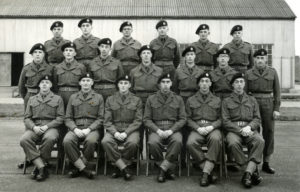
On parade in Gillingham: Royal Engineers cadets were often recruited from technical colleges and universities. Square bashing was our staple diet

However, life was good, work was hard, the food was excellent and the teaching staff were skilled.

We were drilled and exercised, taught bridging, rafting, roadmaking, lifting, explosives and demolitions. We were given handbooks on military engineering and instructions on amending them. In one instance, we were told to change the words from “rearming and refuelling (air) strip” to “refuelling and rearming (air) strip”. This made it clear how precise we had to be…

f15
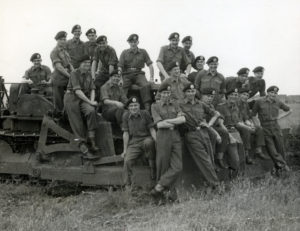
Hugh Fuller (back row, fourth from left) with cadets at Upnor training ground. Fowler bulldozer had cable operated shovel

Bridging was a major item. The Bailey bridge had been invented by a Sapper – Donald Bailey – and was still being used in parts of Europe as a temporary measure. It was simple and ingenious; the steel framed side panels were portable by six men carrying wooden supporting bars between their crooked elbows, and sometimes, on uneven ground, four of them carrying the panel while the other two hung down. Once, when launching a bridge, one of the cadets organizing the construction, found it sliding too far ahead – care had to be taken to make sure that more bridge remained behind the launching rollers to balance it, than projected across any gap.

The cadet supervising the operation, Peter Kearney, got into more trouble for shouting “whoa!” instead of “check” than for putting his foot on one of the rollers, which could have cost him his limb.

Water borne exercises were enjoyable. Building rafts tested the imagination; one comprising three fuel drums lashed together with boards and ropes to form a triangular craft worked satisfactorily until one of its crew changed his position with predictable (and wetting) consequences. Rowing cutters up and down the Medway was hard work and spectacularly badly done.

Water supply was another activity. I was detailed to supervise a water supply exercise, which included the erection of a steel tube tower with a reservoir on top. We landed the components – probably weighing about five tons – onto two three ton trucks. Unfortunately when we came to move off, one of the two truck’s bodies had sunk onto its’ rear wheels and so both had to be unloaded and the contents redistributed to overcome the problem. As the driver unwisely informed us, “I thought that might happen.” Eventually we managed to move off. The tower was erected as planned, and the inflatable storage container positioned on the top of it. The tower was diagonally braced for stiffening purposes, but unfortunately the bracing all ran the same way, and as the reservoir filled, so the tower started to rotate. However, as always, there were enough bodies around to hold everything together until the tower had been properly stiffened. When the whole project was erected we had to pump the container full of water from the nearby lake (pond?) and use a sufficient quantity of purifying tablets to prevent anyone dying from the obligatory consumption thereafter.

For demolitions we were taken to a disused fort beside the River Thames, erected by the Victorians to fire on the French Navy when it might sail up the Thames a century earlier. There we felled saplings with lengths of explosive cord, cut railway lines and made smaller craters with plastic explosive. Some of the cadets managed to retain a booby trapping device and some detonating cord, and bring it back to Gordon barracks. There they baited one of the latrines with a roll of toilet paper, and booby trapped the arm of the flushing cistern. When it was used, the device worked gratifyingly well, and the resultant explosion exceeded expectations, leaving an acceptably traumatised cadet.

Sport played an important part in our character development. I particularly remember two events. Firstly, regimental sports day, when I had to compete in the long jump. Due to an inexpert take-off – and landing – Mr McIver asked me if I thought I was a fucking ballet dancer.

We also had to undergo three round boxing contests with fellow cadets. We were allocated partners of similar height and weight and all generally agreed to make the fighting look aggressive and even painful, whilst not actually harming each other. I was paired with Beverley Fox, a young, keen, ex-public school cadet whom I particularly disliked, and with whom I now saw a chance to show my feelings. Unfortunately, these feelings must have been reciprocated, and even more unfortunately, Beverley proved to be a reasonably proficient boxer. I managed to (just) survive the three rounds, but had to struggle through a deluge of silver stars at the end.

Every month, one of the groups “passed out” or participated in a farewell ceremony. This comprised a parade, slow, in line, eyes right, march past the saluting base in extended lines, a left turn and march away. Unfortunately, during the eyes right past the saluting base, I lost my balance. Thankfully, and as I imagined, skillfully, I regained my balance but did not realise that I was out of step with everyone else. When we turned at the end, I found to my horror what had occurred, and to my dismay when we halted, Mr McIver held out his hand for my weekend leave pass “You ken why, do you not?”

f17
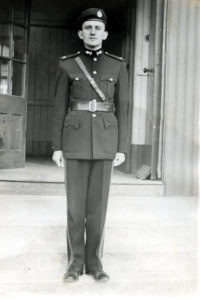
Finished article: Fuller in his officer’s dress uniform, bespoke tailored by Burberry at a cost of about £30 – the equivalent of seven weeks’ army pay

he asked. Indeed, I did, my friends took me to listen to a performance by Ted Heath of curent popular music to console me, which was excruciatingly noisy. It was our turn to pass out the next month. We held a passing out celebratory dance for, which I organised the decorations. Jim Pinnock’s girl friend from Welwyn came as his partner, and we exchanged smiles.

We had been asked what posting we would like. It was made very clear that the preferred destination for any real Sapper officer would be to an Engineer regiment. I put in for a works position where I hoped that I might gain experience in garrison maintenance which would help with my career afterwards. Naturally I was sent to the Transportation branch, otherwise known as Movement Control. (Buggerall movement and fuckall control) which at that time was largely responsible for the movement of troops across the North Sea from Harwich to the Hook of Holland, and then by train to Hannover through Germany by three separate routes. (Blue, green and red)