Part three: out of the ruins comes an engagement ring

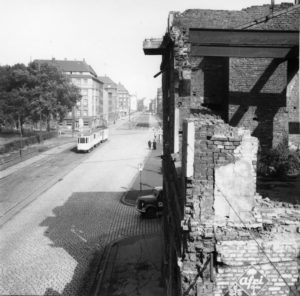
Germany in the nineteen fifties was being quickly reconstructed, unlike London, which was still awaiting repair. Although cities like Köln were still devastated, much was underway elsewhere. Unlike England, where food rationing was still a recent memory, eating out was a real treat, particularly the delicious fruit tortes and cream. With very few exceptions, the people were courteous and welcoming, possibly influenced by the proximity of their communist neighbours. Few soldiers spoke, or tried to learn the language, which did not really matter, as they led a different life and rarely mixed with the local population. It was a recognized jest that a biϊstenhalter was thought to be a bus stop, not a bra… Certain privileges were still available to the occupying forces; fuel concessions, and within garrisons, drink and tobacco were much cheaper. Many pre war cars were still in use, particularly two stroke D.K.W.s with fabric covered outer panels. When a V.W. full of drunken Belgians collided with a municipal tram with all the cars’ passengers dying in the ensuing conflagration, the wreckage was displayed in the town centre with a large board above warning of the perils of drinking and driving. Consumer goods were plentiful and varied, unlike in England.

I was sent to Mönchengladbach, a medium sized town near the larger new military base of Rheindahlen. When I reached my new post I asked what I was expected to do. “Don’t worry, you will be sent on a course at Longmoor in Hampshire,” I was told. Unsurprisingly I was never sent there, and I am still not sure what they would have told me to do hf13ad I done so.
f12

f11
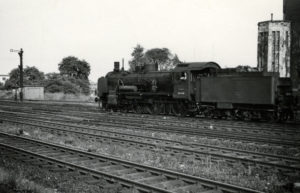
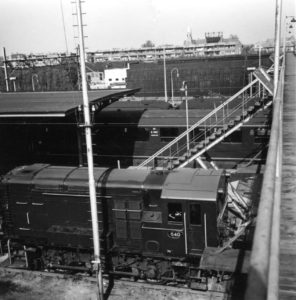
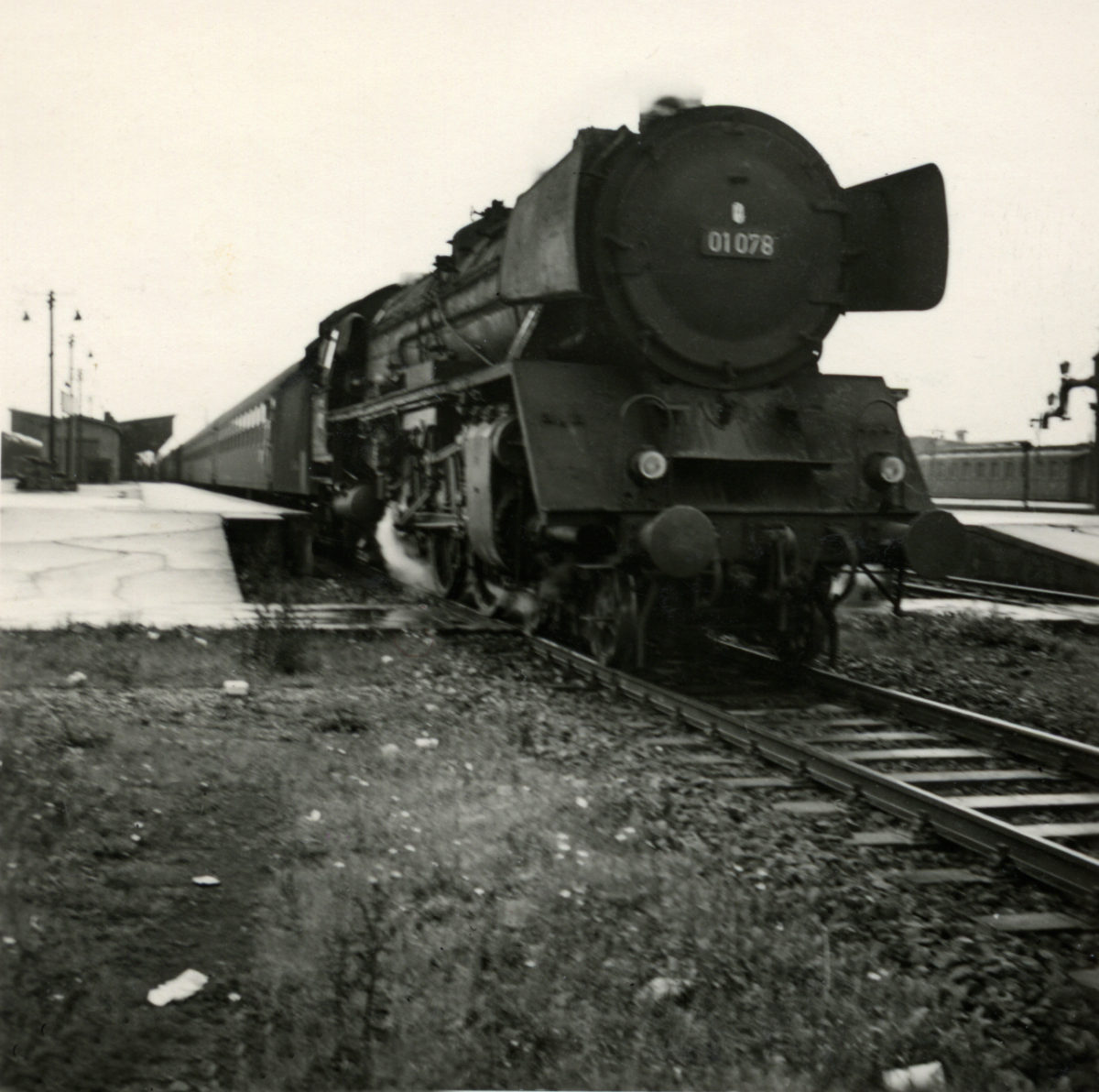
Local locomotives at the small regional German town of Monchenglabach, home to a sizeable British armed forces camp

My new commanding officer was Ben Reeve, a captain in the Suffolk Regiment. He lived in married quarters with his wife, Vera, a forces school teacher. Our offices were part of the Hauptbahnhof (railway station) complex, warm and comfortable. The staff comprised Ben, Sergeant Major Sallows, Sergeant Eglington, Sergeant Snell, Corporal Clarke, two Sappers, several displaced persons who handled baggage, a number of German staff who acted as interpreters and did all the administrative work, and a German driver. Among the civilian staff were whose English language skills were particularly good; Jim Hank and Harry Roten. Jim was the archetypal German, if not Prussian; erect, slightly stout, with short cropped hair, a cigar smoker. Harry was a young man who modelled himself on looking English, while wearing what he felt were English clothes (a bright blue woolen jacket, pale grey cotton trousers, and grey leather shoes). Jim had a slightly cockney twang, Harry, virtually no accent. I once asked how Jim’s English was so good; in spite of his obviously German background, he was in fact English, having been a staff sergeant in World War 1, who stayed on in Germany and married a German girl. He worked at the Ford factory in Köln during the Second World War. Harry’s English was almost accentless, and he always asked us to put him right if he mispronounced any words. He rarely did, however, and this was really the reason one would not think he was English – he had no regional accent. We had an army Volkswagen beetle: dark green with a folding roof, crash gearbox and cable brakes.

The workload was minimal. We had two military (steam) trains each day; one in the morning from the Hook of Holland, and one returning later, from Hannover. We had to see military and some civilian staff on and off these two trains, and occasionally we had to go to another station or depot to hand over paperwork for, perhaps, a consignment of tanks. We also had, once a week or so, trains to and from Klagenfurt, known as the Medloc express – Mediterranean lines of communication. At one time this had carried a slip coach which would be dropped at Mönchengladbach and then reattached to the Hannover train for onward re-routing to Berlin. Sergeant Eglington was said to have somehow contrived matters so that the Medloc coach was sent back to Austria where it had originated instead of Berlin, and attached the slip coach for Berlin to the Hook of Holland train.

As we were based at the nearest main railway station to the Rhinedalen headquarters, we had our fair share of VIP staff travelling through. Very often they would travel back on the evening civilian express, and frequently with their wives. It was not unusual to have to escort an elderly retired staff officer and his consort, find them their reserved seats, put their baggage on the rack, salute and say farewell. As the train only stopped for two minutes, it was usually travelling between five and ten miles an hour by the time we baled out, our studded boots skating along the platform

Mönchengladbach was a good posting; the actual mess was a large corner dwelling near the opera house, and our sleeping quarters were a short distance away in the the same road. The soldiery lived comfortably nearby. Those using the mess were from a variety of corps and regiments; the president was from the Royal Army Service Corps and there were officers from REME, a cavalry regiment, signals, sappers and others. The waitresses who looked after us were upmarket German ladies, and my batman was a middle aged German.

My first (monthly) mess dinner evening, when everyone wore ceremonial dress uniform, or “blues” ended disastrously. The second lieutenants from R.E.M.E. showed me the ropes, and we were treated to a good meal. At the end of it, and after the formalities, which included drinking the Queen’s health, we left the table and moved to the bar. On of my new R.E.M.E. friends then said that he’d had enough and thought he would leave; the other agreed. It seemed a trifle premature to me, but as they were more experienced, I assumed we would not be breaking any rules. Luckily(?) we asked the colonel’s permission first. Colonel Kennedy did not respond as we might have hoped. “Leave?” He asked. “Yessir”, “Why?” He demanded. One of my companions explained that we wished to go to bed. This proved to be the blunder of the evening. “Not only will you not be allowed to leave now, but I will personally ensure that you three will be the last to leave tonight.” End of story!

We could pay sixpence (old money!) to travel to the cinema by the garrison VW personnel carrier; at headquarters in Rhinedalen where there was an army and an RAF cinema.

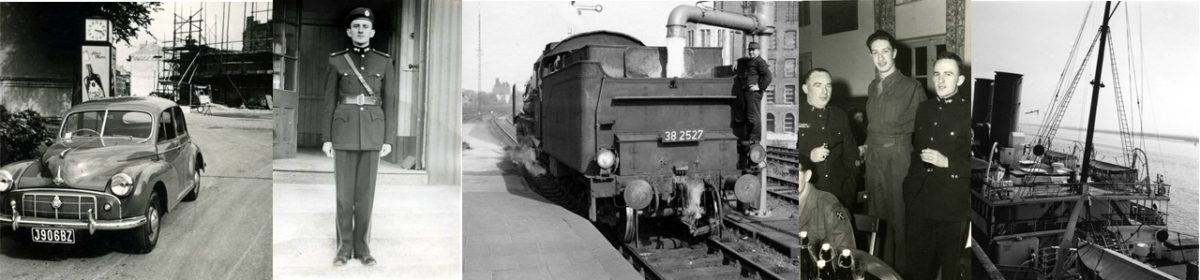
Drink was cheap: threepence old money for a single measure of spirits, and cigarettes were only eleven pence for twenty or a shilling for Players Perfectos – the ultimate smoke. Düsseldorf, Köln, and the Eiffel mountains were nearby. My CO’s wife introduced me to a young teacher friend, Joan Dawson, and life was very comfortable, improved further by the use of my car, a Morris Minor, which I brought over on the Dover to Calais ferry, and which facilitated viewing the locality.

We explored Düsseldorf night life with the help of a duplicated copy of “Bon Viveurs Alternative Guide.” We (the R.E.M.E. subalterns and I) were set on viewing a totally naked artiste, but disappointingly all we saw were ageing topless dancers, and drank expensive, poor quality, fizzy white wine. We went in Graham’s elderly Opel which had a front wheel tyre burst on the return early morning journey, luckily without any consequent problems. Graham worked at the local Rhine army workshops, where they reconditioned elderly half track vehicles. They told me the majority of repaired trucks failed before they had covered a thousand miles.

Suddenly everything changed. I received a letter from England which reminded me why I was where I was when I was. Ann had written asking after me. She did not know I was in the army and in Germany. I replied cautiously – she said insensitively – saying that I would be pleased to meet her in Düsseldorf any time she happened to be there. I did not want to sound too eager and to find that matters had not really changed.

However the next letter I received told me that she had borrowed a hundred pounds from her mother and was indeed coming to Düsseldorf as soon as it was convenient.

I arranged with Vera Reeve to put her up, and with Ben for me to take time off to show her around.

I met Ann off a Dakota of the British European Airways flight. We went to Köln for a day’s outing, climbed the southwestern cathedral tower, I proposed and – luckily – was accepted. We visited a jewellers in the devastated city, and bought a ring. We returned home to Mönchengladbach way of Monschau in the Eiffel Mountains and spread the glad news. Mother and father were shocked: they thought a long engagement would be sensible. Ann did not agree, and nor did I, for I didn’t want her to have the opportunity of a further change of heart. We eventually settled for just under a year; effectively, as soon as I was demobilised. Reports upon the arrival of my letter announcing my betrothal varied – one of my brothers said father was enthusiastic, but both agreed that my poor mother was distraught (wait and see, she’ll do it again!).
Part four: life in devastated Germany

f3
Dortmund 10 years after the end of the war. Reconstruction was well under way, although much remained to be done

Soon after this I was told that I was to be posted to Dortmund as Rail Transport Officer in my own right. This was an enviable post; some fifty miles from headquarters; the station served a number of regiments in the area, including infantry a local Field Engineer regiment, a survey squadron, and an armoured regiment. My predecessor, John Launder, showed me around, and although he had struck up a strong friendship with the neighbouring Canadian R.T.O. is Söest, I soon made my own, different, acquaintances. I moved in with the local garrison, which had a similar complement to the one I had left at Mönchengladbach, and life began again.

f10
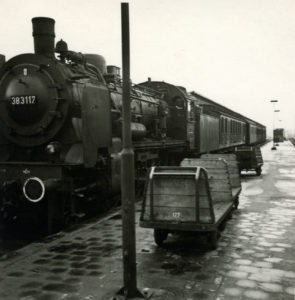
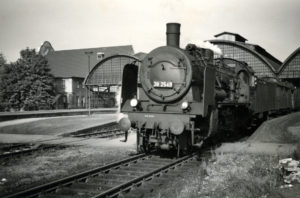
Local train at Dortmund station, heavily bombed in the war
f6
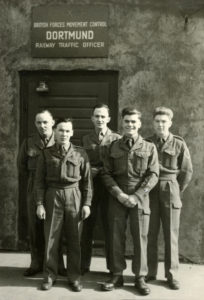
From back row left: Sergeant Major Carol, Second Lieutenant Fuller, Corporal Martin; front row: Sappers Morley and Mitchard

Dortmund had taken a hammering from the RAF. It was just over ten years since the end of the war, and reconstruction was well under way. The R.T.O.’s office was on platform four, and comprised two small rooms. The innermost was occupied by the German staff, who did all the clerical work. Well, all the work, really. The outer office was for the military. These were myself, Sergeant Major Carol, Corporal Martin, Sappers Mitchard, Howe, and Morley. There was also Karl, the German driver, who was generally disliked by everyone else. Commonly supposed to be an ex-Hitler Youth member, Karl lived with his mother who was considered to be far too tolerant of his louche behaviour.

Corporal Martin felt a particular antipathy towards Karl, and discovered that he regularly used the unit’s Volkswagen to travel home at lunchtime. Corporal Martin pointed out that Karl had adapted his work tickets to accommodate the extra mileage, and painted a colourful picture of the result of any investigation. How likely this might ever have been, I have no idea, but the upshot was that it was considered better to rid ourselves of Karl before anything happened.

f4
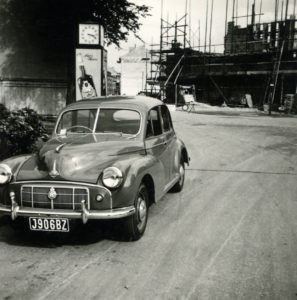
Fuller’s personal Morris Minor, which he drove 375 miles from London to Dormund, solving his transport challenges

After Karl left, we had no driver, as no one one else held a licence, and I had to take his place, although it was considered unadvisable for officers to drive, in case of any additional embarrassment in the event of an accident. I drove for some time, while waiting for a replacement for Karl. On one occasion we had to go out in the middle of a very cold January night to supervise the entrainment of a squadron of tanks some distance away, and the V.W. refused to start. The only way I was able to move it was to ask the regimental fire picket to tow it around the camp until it came to life. Eventually we were given another civilian driver, Helmut, and the problem disappeared.

Life at the garrison was very relaxed; the small amount of work was similar to Mönchengladbach – two trains each day, and some freight traffic, but no V.I.P.s.

Mr Carol generously invited me to snooker in the sergeants mess. Karl collected us by car each morning, took us back for midday meal and back again to the garrison at the end of the day. There was little activity in the office, and by way of diversion, I organised a visit to a local coal mine, a steel works, and once a visit to the Volkswagen factory in Wolfsburg. On each occasion we were generously entertained with food and drink by our German hosts. The mine was very modern; I had long wanted to visit one, and the Germania was impressive. I was surprised by the brick lined tunnelling at the foot of the main shaft; I was also surprised to hear that Welsh miners were working there. The actual horizontal shafts sloped about 10” and the headroom was about 5’.

We were shown over the steel works at Duisberg at the same time as a party of cadets from Shrewsbury College, and the lad I sat opposite at lunchtime came from Knutsford, and knew Ann’s family.

When we went to Wolfsburg we were given lunch in a local hotel where I saw the only piano roll instrument I have ever come across. This was a long journey – some two hundred miles each way, and even on the Autobahn it took at least four hours each way.

The two bilingual German clerks were Herr Bock, a wild looking escapee from the East, whose mother had avoided rape by the Russians by convincing them that she was suffering from venereal disease, and Manfred Pladdies, a younger ex soldier who became a good friend. Manfred had fought in Russia and Italy, as well as on other fronts, and had been quite badly wounded in the neck; he had a glass eye. He kept the bullets that had been removed from his body on a table in his living room. His memories of the war in Russia included waiting for a dawn attack and seeing some ripe apples growing on the other side of a wall behind which his troop was sheltering. As they were all ravenous, one of his companions decided to jump over the pick some fruit. His reward was to land in a midden and to finish up covered in slime – catastrophic in the circumstances, where no washing facilities existed.

Although I had lived through the Nuremburg Trials of the Holocaust perpetrators, I do not recall reading about these events at the time. While at Dortmund I read a copy of “The Scourge of the Swastika” by Lord Russell of Liverpool, which was a detailed account of the atrocities, and was horrified by them.

I discussed the book with Manfred and his fiancé Elfriede, which I lent them. Their reactions were interesting; they largely accepted the truth of the accounts, but implied that these were exaggerated and even wrong in some respects such as the Nazi female official who had fashioned lamp shades from the skin of victims. As far as Manfred was concerned, they had been aware of the persecution, but not the full extent of it, and whilst not condoning the terrible treatment meted out, like many other Germans believed that many victims were gypsies, psychopaths, homosexuals, and other persons considered undesirable by the German authorities. I think it would be fair to say that like many of their countrymen, they were unwilling to believe that their nation could actually behave in such an amoral fashion.

Manfred and Elfriede, who said that she had once shaken hands with Hitler at a pre war Nazi gathering, lived in Essen, where I was regularly invited to tea on Sundays. They eventually married, divorced, and came together again, in spite of Manfred’s drink and woman problems. Years later Manfred became Godfather to our youngest son; when he was around six years old, Manfred and Elfriede visited visited us in London. Manfred was sitting in our kitchen, drinking coffee and surrounded by William’s young friends all agog at speaking to a real German. Manfred says to them all: “I tell you what, we Germans are tough” and taps his glass eye with a fingernail. His audience immediately vanishes….
One weekend Manfred invited me to spend a couple of nights with his sister and brother in law, Herr Doktor Bals, in Wiesbaden. I had an enjoyable weekend; we visited Frankfurt where I took Pam, a friend from home who worked at the embassy, out to lunch. In the evening we visited the local casino; I lost a pound (!) Manfred, I am sure, quite a lot more.

steam train dortmund germany 1950s
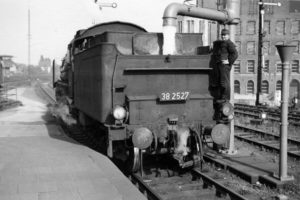
Manfred arranged the trip on the footplate of a steam locomotive such as this one in Dortmund station

Manfred also asked the driver of an express if I could sample a ride, and I travelled into Hamm on the footplate. The Germans, as ever, were proud to demonstrate the capabilities of their locomotive which I was told had a speedometer – unlike (?) an English engine, and which showed we were travelling at speeds of nearly 100 kph. The feature that struck me most forcibly was the sway of the engine itself as the connecting rods pulsated on each side. I was able to travel back to Dortmund free, and quite sedately as a passenger in a local train.

After living in the garrison for several months, it was decided that we would all be better off billetted with the local Sapper Regiment – 23 Field Engineer Regiment. They were quartered in the Luftwaffe camp; a very comfortable place; where the lofty officers mess dining room had a musicians gallery at one end.

I there met the second murderer of my acquaintance, a first lieutenant, Peter Poole. He was originally from Essex and had served in the African Police before joining the army. He was almost universally unpopular for his abrupt and arrogant manner; he was the butt of any spiteful horseplay on mess nights. Some time after I left the army, a man of the same name was accused in Africa of murdering his house boy who had been taunting his dog, and who turned out to be the same person. Peter Poole was tried, found guilty and sentenced to death. Peter, however, knew that his offence did not warrant such a reward, and was completely confident that the Queen would grant him a reprieve. Unfortunately for him, the wind of change was blowing in Africa, and the colony was emerging as an independent state. Peter Poole was duly hanged.

f7
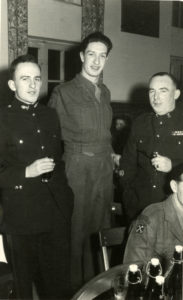
Fuller (left) with Sapper Howe and Sergeant Major Carol in dress uniform at the ex-Luftwaffe barracks in Dormund

I met a Sapper officer many years later at a City of London lunch. We got talking, and I recognised his name – a major, subsequently colonel, Perkins. I asked him if he had known Peter Poole, and I was curtly informed that Peter had been in his squadron, and had been a good friend of his and of his wife…

I was able to visit the local tourist sights, which included the picturesque Rhine valley and the Eiffel forest.  I went to a pony trotting event and with another R.E. lieutenant to sail across the Möhne dam.  Unfortunately during this last outing, my companion wound up the centreboard of the army dinghy so vigorously that it somersaulted out of the bottom of the boat, and disappeared.  Luckily, the loss was overlooked.

In the summer of 1956, 28 Field Engineering regiment staged a ball. This was a spectacular affair – it lasted throughout the night and finished with a generous breakfast.

Part five: stop that train!

f2
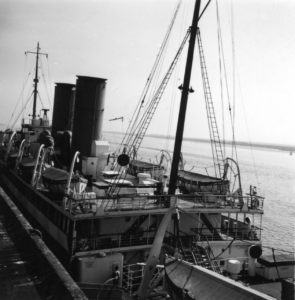
Hook of Holland dockside from roof of the embarkation sheds. Inter-war ferry was typical troop transport

The Suez crisis erupted. Reservists were sent out from England to retrain in Germany, and Movement Control staff were sent down to the Hook of Holland to help handle the extra traffic. The two troop ferries; the Vienna, a converted civilian ship, and The Empire Wansbeck, which I believe had been a minesweeper, did double trips, and an extra tho
usand or so troops arrived each day in the early evening. The usual boat arrived every morning and the RTO staff ate breakfast in the mess before seeing the trains filled. They then ate a second meal on the train. They were served by the ‘wagon lits’ staff; the food was no problem to eat, as we all had risen early, and had usually completed our day’s’ work by nine or ten in the morning.

Manfred arranged the footplate trip on the steam locomotive such as this one in Hook station
Trains at the Hook of Holland, where Fuller served on the  Rail Transport Staff and helped to marshal troops from boat to train

The Hook was comfortable; we lived in Nissen Huts and except when the troops were actually moving through – breakfasts for a hundred or a thousand, depending upon North Sea weather – we were chiefly left to our own devices. We visited Rotterdam, Scheveningen, The Hague and areas of Holland, made easier for me by having the use of a car.

To transport the reservists into Germany, additional daytime ferry sailings were arranged and supplementary military trains run to deal with the extra numbers.

The soldiers themselves were poorly disciplined. There was not much enthusiasm for the Suez adventure, and many of the troops were in the logistical branches rather than front line soldiers. They came ashore in the warm August weather wearing their battledress blouses, but unbuttoned, and with their berets tucked under their epaulettes. Their non-commissioned officers were disenchanted with their return to the military environment that most of them thought they had put behind them when they had been demobilised. I do not remember how the officers appeared, but the overall impression was of an unwilling and unhappy group of conscripts. Unlike recruits coming in for the first time, they had seen it all before, and resented this attempt to recall them. The regular army warrant officers however, had no trouble in handling them.

One evening, the first train came into the platform early. Sergeant Major Webb jumped off and came down the platform.

“Evening, Mr Fuller – what time do I go back?”
“Nine o’clock, Mr Webb.”
“I’ll just go down to the NAAFI, and have a cup of tea.” Mr Webb disappeared

The second train came in a few minutes later, Sergeant Major Bird came down the adjacent platform toward me.

“What time does the train leave, Mr Fuller?”

“Nine o’clock, Mr Bird.”

Mr Bird followed Mr Webb to the NAAFI. Unaccountably, although I knew the first train left at eight forty five, I had given both men the time of the second departure, with results that would shortly become all too apparent.

The reservists now trailed onto the platform. Although soldiers were never marched up to the train, these men somehow managed to make the whole operation informal to the point of indiscipline. They were commanded by their own NCOs and officers, and their behaviour among themselves was no concern of mine, but I was thankful that there was a regular army warrant officer commanding the train.

The Dutch railway official came up to me when everyone was embarked and asked if everything was ready for departure. I confirmed that it was, whistles were blown and the train load of what I privately thought of as a football type hooligans slowly moved away.

Just as the tail lamps of the last coach disappeared from view, Mr Webb came panting up the platform. This time he didn’t even waste time on a perfunctory salute.

“What time did you tell me my train was leaving, Sir?”

A nasty moment. However, it was clearly my fault, so I might as well admit it straight away.

“I told you nine o’clock, Mr Webb, but I should have told you eight forty five.”
“What should I do now, Sir?”

This was a real poser, but there seemed to be only one practicable solution.

“Don’t worry, I will have the train stopped.”

I could clearly see the result of leaving a trainload of reservist vandals careering across Holland and Germany with no responsible person in charge. My imagination drew a picture of a train with all the fittings loosened – perhaps thrown out of the windows. The reservist officers and NCOs would have no chance against this band of potential mutineers. The guard even less so. I would be the person ultimately responsible for this disaster which would reflect upon my Corps, the British Army, England…

I hastily found the stationmaster and explained what I wished him to do. He did not seem wholly enthusiastic about my proposal, but agreed to arrange to have the train halted.

Unfortunately this proved to be rather less easy than I might of imagined. To just stop a train that has had its path arranged all the way to Hanover is not like stopping a bus and asking the driver to hang on for a few minutes as the conductor has been left behind.

They did indeed manage to stop the train; by the time a suitable place had been found, it had reached the Dutch border about an hour away from the Hook. The stationmaster approached me with a blank expression on his face, and asked me what I would like to do next.

I explained that I would send the sergeant major to catch the halted train. I arranged for Mr Webb to be taken out in one of the garrison Volkswagens, and when the driver returned about midnight, he told me that Mr Webb had caught the train, which as far as he could tell, was still in one piece.

I was pleased at this successful outcome of my rescue plan. With no help other than the resources I had called upon, I had avoided a mutiny and saved the day. If one overlooked the fact that the whole problem had been caused by my own incompetence, the way it was dealt with showed a flair for prompt decision and supporting action.

I did not ever consider it necessary to make a formal report about the evening’s events to my superior officers. In the light of subsequent events this might have been considered less than prudent.

Ten days later I was given a message to report to Major Butler, my commanding officer.

I had no premonition of any problem; and when I entered Major Butler’s office, he was, as ever, courteous and pleasant.

“Good morning Fuller, I expect you know why I have asked you to come and see me?”

I had no idea at all. My escapade with the halted train was past history, and I had managed to put it out of my mind. The second train had left on time, and if I thought about it at all, which I doubt I did, I would have considered the whole event nothing more than a slight administrative hiccup.

“The Dutch Railway authorities have reported that a military train was delayed at the Dutch Border for nearly two hours the other night on your instructions; can you explain to me what happened?”

My stomach felt as if someone had just punched it. However, the facts were straightforward enough, so all I had to do was explain what I had done.

“Well, Sir. There were two trains returning to Germany that evening, and for no reason other than my own stupidity, I told both TCWOs that their trains left at nine o’clock, when in fact one left fifteen minutes earlier. As a result, the first train left without anyone in charge, and I felt the best course of action would be to stop it and send the sergeant major out to catch it. Dutch Railways were unable to stop it any earlier, but I had hoped that my actions would be the best solution to the problem.”

Major Butler rubbed his chin.

“I appreciate your frankness Fuller, but the War Office have received a bill for £600 from the Dutch Railways, and I think we will have to think of a rather better excuse than the one you have given me. You may go.”

I went. I never found out what his story was, but the bill was never passed on to me, for which I was truly thankful, representing as it did nearly three years pay!

When the time came for my demobilisation, I had to return by the civilian ferry from Calais. I asked Major Butler what formalities I had to undergo, and he said “Just leave”. I could hardly believe it could be so simple, but as it was an order, I left.

I was due to be married in two weeks time, and when I reached home everyone was busying themselves for the forthcoming event, which was to be in Cheshire, which for my family was as remote as the Trossachs.

On the Thursday after my return, I had a message to contact the War Office. When I returned the call and gave my name, I was told that I had orders to report to Longmoor Camp the following Monday. “But I am due to be married in two weeks time!” “Can’t help that, the orders are clear and confirmation is in the post.” I assumed that the problem was yet another consequence of the Suez upheaval, but my whole family went into panic mode, as may be imagined. Luckily I had a solicitor uncle, who had a contact at the War Office who was persuaded to look into the matter. The result was that a lieutenant Fuller had indeed been given a posting to Longmoor, but that this lieutenant H. Fuller, had omitted to surrender his army paybook before leaving Holland. And would he please send it on to the appropriate War Office department?

img_0561
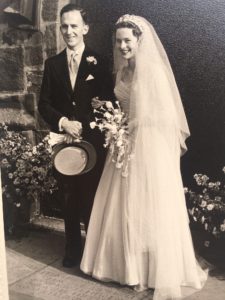
Hugh and Ann Fuller on their wedding day on 13 October, 1956

I was married on the 13th October, and life changed once more as Ann and I set up house in Walthamstow in East London. I returned to work for my old employers, commuting into Stratford each day, and returning to attend classes several evenings of the week in order to complete my unfinished exams. My paternal uncle, who ran half the family building business, became a widower at the end of the year, and decided to retire; my cousin and I then joined the company, and continued to work for it for some forty years. Ann and I were fortunate in having five children. The business (generally) prospered and survived until the late nineteen hundreds, when my cousin and business partner decided to retire.