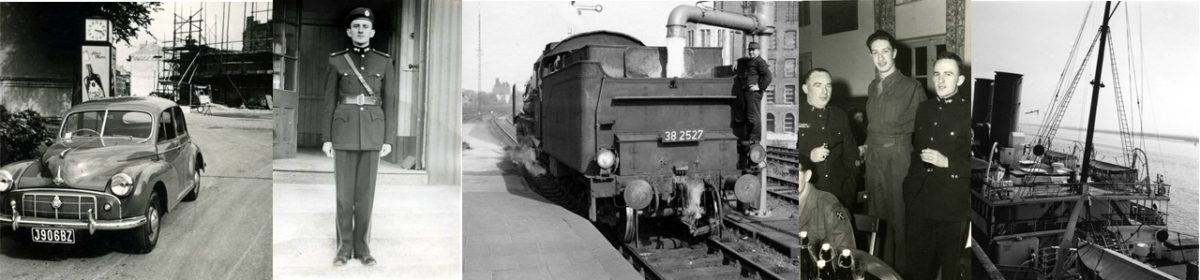
My earliest recollection of the vagaries of military travel was my father’s homecoming on leave during the winter of 1940/41. Father, who had worked in the family building business for some 10 years, had enlisted in the Territorial Army in 1939, and hoping that his experience in the construction industry might be of use, had joined the Royal Engineers. He was naturally assigned to a searchlight unit, in which he remained for several months until the army decided that searchlights were more appropriate partners for the anti-aircraft gunners, and he was transferred to the Royal Artillery.
At the time of his leave, he was a sergeant in the orderly room of a regiment in the North of England and was travelling home to London via Coventry. He managed to find a seat in a third class compartment, put his belongings, including his greatcoat, on the luggage rack, and made himself comfortable. As he leant back in his seat and prepared to nod off, the door to the corridor was opened, and with some dismay he recognized the adjutant with whom he worked signalling his attention. The adjutant asked him if he would leave his seat and join him in the First Class compartment further down the train. Father pointed out that as an N.C.O. he only had a third class travel warrant and that he was unable to accept his invitation.
“Nonsense” replied the adjutant “I will speak to the ticket inspector and make things alright.”
Against his better judgement, father agreed to the move and made his way down the train. When they reached the First Class compartment the other occupants comprised three civilians, two of which turned out to be friends or colleagues of each other; the third, a somewhat taciturn individual, was a stranger to everyone else.
The two who were acquainted halted their conversation upon the entry of the newcomers and then resumed their discussion on the shortcomings of the wartime railway systems; their poor punctuality, lack of cleanliness and generally low levels of service, with plentiful examples of experience to illustrate their complaints.
After a while there was a pause in their diatribe, the third civilian; who had previously remained silent, spoke. “Excuse me, gentlemen, I could not help overhearing your remarks about the state of the railways, and as I work for them, I feel I should say a word in their defence.”
The other two rounded on him. “You would make excuses, wouldn’t you.”
The railwayman demurred, “Seriously, the railways have had to deal with enormous problems. They were starved of investment during the inter-war years, and when this war started they suffered a drastic shortage of staff due to enlistment. They experienced a shortage of supplies, and have had to deal with above average damage from the enemy bombing campaign.”
The other two were not mollified. “You are bound to make excuses if you work for them. They could do a lot better if they were properly organized, in the way that the industry for which we work gets to grips with problems.” And so on…
The railwayman waited for another pause “Have you been warned of the problems to expect tonight?”
“No, and this bears out the validity of our argument; what problems?”
It was at this time about seven p.m., a dark winter’s night.
“The railway system has been warned by the authorities of impending air raids in the Coventry area and as a result this train will be diverted, and will not unfortunately stop at Coventry.”
“But we are travelling to Coventry! This is the limit. Not only dirty and slow, but totally unreliable.”
“However, I hope that I may be able to improve your gentlemen’s opinions of our railway, as I may be able to help you reach your destination with the minimum of delay.”
The railwayman explained that although the original scheduled arrival time in Coventry was eight twenty p.m., it had been found necessary to divert the train to travel through Rugby, and to allow passengers to alight there instead. Protest ensued from the other two: “This confirms our worst fears”, etc.
“Due to an improved journey time we will be travelling around Coventry earlier than originally expected and we will be going through a station not far from the city centre at around seven fifty p.m. The train will not stop here, but will slow to a walking pace. If you throw out your baggage and jump out onto the platform you will only be a few minutes’ walk from the main station and you might actually arrive there earlier than originally expected.”
The two companions thanked him in rather grudging terms; one observed to the other it would be good if they reached their homes early, and how pleased their wives would be. A desultory conversation ensued and some of the passengers slept.
At half past seven, the railwayman explained that he had to leave the train in the Birmingham area, and took his leave of the others. Before he left he wagged his finger at the two civilians and reminded them to follow the instructions he had given them: “Get off the train at ten to eight and you will be there in good time.” The train rattled on its way.
Just after a quarter to eight, the brakes of the train ground on, and the coaches slowed. The two companions checked their watches, agreed that events were proving to be as expected and left the compartment.
Being wartime, the platform lighting was minimal. The two soldiers moved the roller blinds slightly and saw a platform appear alongside. The train slowed down to what seemed a snail’s pace and two figures landed on the paving outside. As the station fell behind the train picked up speed and settled on its way.
Half an hour later, it slowed again and stopped. Father and the adjutant pulled the blinds aside expecting it to be Rugby Station, but when they eventually managed to identify a sign, it was Coventry….
Father’s other tale of travel, also a wartime event, was a particular favourite, as he felt he had been delivered by a Divine Providence. It was 1942; he was now a captain in the Pioneer Corps, and had been posted to Sierra Leone. He was sent to Liverpool to catch a ship and he and another officer were duly sent by launch onto a waiting trooper. They had barely been aboard when a message came over the loudspeaker system telling both of them to report immediately with their baggage, to the Embarkation Station Staff Officer, ashore.
Fortunately, the launch had not left the ship and was able to return them to the dockside.
When they reported to the E.S.O., he asked them what they wanted. When they replied that they had come in response to his summons, they were told he had no idea what they were talking about and to return to the ship.
The ship had sailed – it was subsequently torpedoed, Father was told – but the two men travelled by a later boat to Freetown without any further problems.