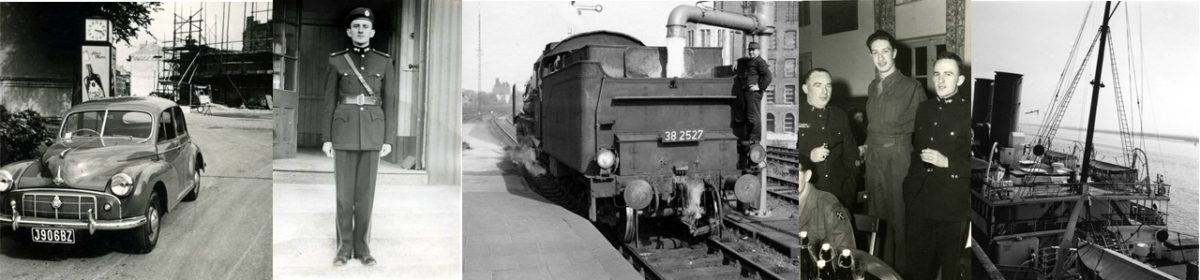
Luckily – and I do mean, luckily, I was considered suitable for further cadet training, when I had returned to Guilliemont. The successful entrants were then posted to Mons barracks at Aldershot, where other cadets from the non-infantry arms were given six weeks basic military officer training, which included drill, some by the famous/infamous regimental sergeant major Britain, aspects of administration, and military law. This latter item included an anecdote about a man and woman alone in a train compartment. The woman suddenly says to the man “Unless you give me five pounds, I will pull the communication cord (emergency stopping device), and say that you tried to rape me.” The man replies, “On the contrary madam, if you don’t give me five pounds, I will rape you.” I cannot remember the particular aspect of military law this illustrated, but it made the lessons memorable, if not the actual issue raised.
GILLINGHAM
After our six weeks at Mons, which were less rigorous than our Sapper training, we were sent to Gordon Barracks at Gillingham, an offshoot of the school of Military Engineering at Chatham where real soldiers trained. We travelled there by train. In those pre-Beeching years (?possibly still), it was feasible to go from Aldershot to Chatham by rail. When we reached Gillingham we were formed up in fine military style – after all we had been in the army all of three months, now. Sergeant Major McIver inspected us. He was less obviously impressed by our turnout, and explained that he was known as “Black Mac” for reasons that he would make obvious. He explained that there were two ways to complete our course; “The hard way, and the fucking hard way.” In fact he misled us; there was no choice, as the first alternative did not exist. We were given upgraded kit items – a white plastic disc behind our cap badges and white gorgette lapel tabs on our battledress collars.
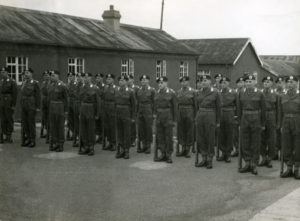
However, life was good, work was hard, the food was excellent and the teaching staff were skilled.
We were drilled and exercised, taught bridging, rafting, roadmaking, lifting, explosives and demolitions. We were given handbooks on military engineering and instructions on amending them. In one instance, we were told to change the words from “rearming and refuelling (air) strip” to “refuelling and rearming (air) strip”. This made it clear how precise we had to be…
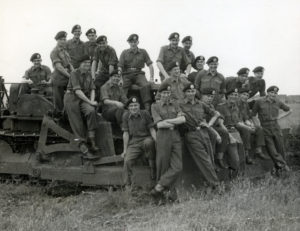
Bridging was a major item. The Bailey bridge had been invented by a Sapper – Donald Bailey – and was still being used in parts of Europe as a temporary measure. It was simple and ingenious; the steel framed side panels were portable by six men carrying wooden supporting bars between their crooked elbows, and sometimes, on uneven ground, four of them carrying the panel while the other two hung down. Once, when launching a bridge, one of the cadets organizing the construction, found it sliding too far ahead – care had to be taken to make sure that more bridge remained behind the launching rollers to balance it, than projected across any gap.
The cadet supervising the operation, Peter Kearney, got into more trouble for shouting “whoa!” instead of “check” than for putting his foot on one of the rollers, which could have cost him his limb.
Water borne exercises were enjoyable. Building rafts tested the imagination; one comprising three fuel drums lashed together with boards and ropes to form a triangular craft worked satisfactorily until one of its crew changed his position with predictable (and wetting) consequences. Rowing cutters up and down the Medway was hard work and spectacularly badly done.
Water supply was another activity. I was detailed to supervise a water supply exercise, which included the erection of a steel tube tower with a reservoir on top. We landed the components – probably weighing about five tons – onto two three ton trucks. Unfortunately when we came to move off, one of the two truck’s bodies had sunk onto its’ rear wheels and so both had to be unloaded and the contents redistributed to overcome the problem. As the driver unwisely informed us, “I thought that might happen.” Eventually we managed to move off. The tower was erected as planned, and the inflatable storage container positioned on the top of it. The tower was diagonally braced for stiffening purposes, but unfortunately the bracing all ran the same way, and as the reservoir filled, so the tower started to rotate. However, as always, there were enough bodies around to hold everything together until the tower had been properly stiffened. When the whole project was erected we had to pump the container full of water from the nearby lake (pond?) and use a sufficient quantity of purifying tablets to prevent anyone dying from the obligatory consumption thereafter.
For demolitions we were taken to a disused fort beside the River Thames, erected by the Victorians to fire on the French Navy when it might sail up the Thames a century earlier. There we felled saplings with lengths of explosive cord, cut railway lines and made smaller craters with plastic explosive. Some of the cadets managed to retain a booby trapping device and some detonating cord, and bring it back to Gordon barracks. There they baited one of the latrines with a roll of toilet paper, and booby trapped the arm of the flushing cistern. When it was used, the device worked gratifyingly well, and the resultant explosion exceeded expectations, leaving an acceptably traumatised cadet.
Sport played an important part in our character development. I particularly remember two events. Firstly, regimental sports day, when I had to compete in the long jump. Due to an inexpert take-off – and landing – Mr McIver asked me if I thought I was a fucking ballet dancer.
We also had to undergo three round boxing contests with fellow cadets. We were allocated partners of similar height and weight and all generally agreed to make the fighting look aggressive and even painful, whilst not actually harming each other. I was paired with Beverley Fox, a young, keen, ex-public school cadet whom I particularly disliked, and with whom I now saw a chance to show my feelings. Unfortunately, these feelings must have been reciprocated, and even more unfortunately, Beverley proved to be a reasonably proficient boxer. I managed to (just) survive the three rounds, but had to struggle through a deluge of silver stars at the end.
Every month, one of the groups “passed out” or participated in a farewell ceremony. This comprised a parade, slow, in line, eyes right, march past the saluting base in extended lines, a left turn and march away. Unfortunately, during the eyes right past the saluting base, I lost my balance. Thankfully, and as I imagined, skillfully, I regained my balance but did not realise that I was out of step with everyone else. When we turned at the end, I found to my horror what had occurred, and to my dismay when we halted, Mr McIver held out his hand for my weekend leave pass “You ken why, do you not?”
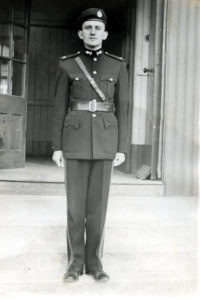
he asked. Indeed, I did, my friends took me to listen to a performance by Ted Heath of curent popular music to console me, which was excruciatingly noisy. It was our turn to pass out the next month. We held a passing out celebratory dance for, which I organised the decorations. Jim Pinnock’s girl friend from Welwyn came as his partner, and we exchanged smiles.
We had been asked what posting we would like. It was made very clear that the preferred destination for any real Sapper officer would be to an Engineer regiment. I put in for a works position where I hoped that I might gain experience in garrison maintenance which would help with my career afterwards. Naturally I was sent to the Transportation branch, otherwise known as Movement Control. (Buggerall movement and fuckall control) which at that time was largely responsible for the movement of troops across the North Sea from Harwich to the Hook of Holland, and then by train to Hannover through Germany by three separate routes. (Blue, green and red)