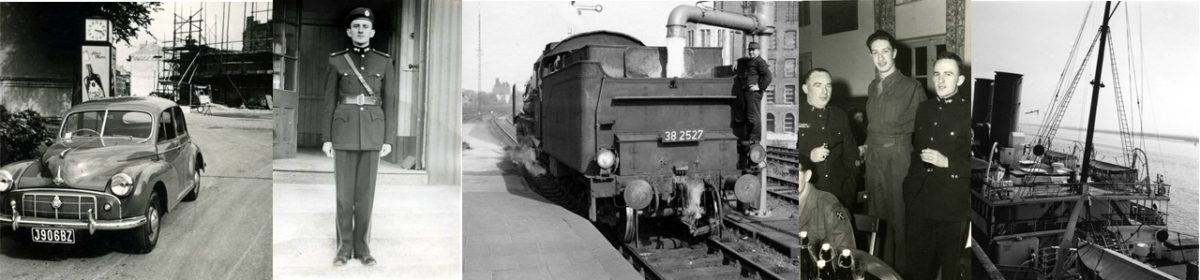
Soon after this I was told that I was to be posted to Dortmund as Rail Transport Officer in my own right. This was an enviable post; some fifty miles from headquarters; the station served a number of regiments in the area, including infantry a local Field Engineer regiment, a survey squadron, and an armoured regiment. My predecessor, John Launder, showed me around, and although he had struck up a strong friendship with the neighbouring Canadian R.T.O. is Söest, I soon made my own, different, acquaintances. I moved in with the local garrison, which had a similar complement to the one I had left at Mönchengladbach, and life began again.
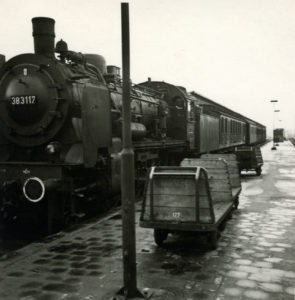
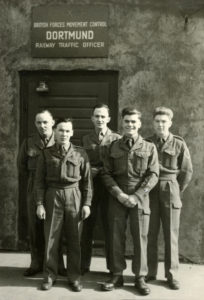
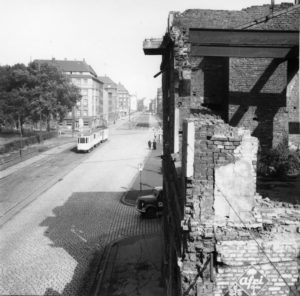
Dortmund had taken a hammering from the RAF. It was just over ten years since the end of the war, and reconstruction was well under way. The R.T.O.’s office was on platform four, and comprised two small rooms. The innermost was occupied by the German staff, who did all the clerical work. Well, all the work, really. The outer office was for the military. These were myself, Sergeant Major Carol, Corporal Martin, Sappers Mitchard, Howe, and Morley. There was also Karl, the German driver, who was generally disliked by everyone else. Commonly supposed to be an ex-Hitler Youth member, Karl lived with his mother who was considered to be far too tolerant of his louche behaviour.
Corporal Martin felt a particular antipathy towards Karl, and discovered that he regularly used the unit’s Volkswagen to travel home at lunchtime. Corporal Martin pointed out that Karl had adapted his work tickets to accommodate the extra mileage, and painted a colourful picture of the result of any investigation. How likely this might ever have been, I have no idea, but the upshot was that it was considered better to rid ourselves of Karl before anything happened.
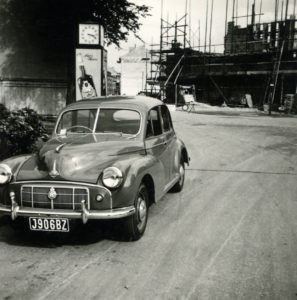
After Karl left, we had no driver, as no one one else held a licence, and I had to take his place, although it was considered unadvisable for officers to drive, in case of any additional embarrassment in the event of an accident. I drove for some time, while waiting for a replacement for Karl. On one occasion we had to go out in the middle of a very cold January night to supervise the entrainment of a squadron of tanks some distance away, and the V.W. refused to start. The only way I was able to move it was to ask the regimental fire picket to tow it around the camp until it came to life. Eventually we were given another civilian driver, Helmut, and the problem disappeared.
Life at the garrison was very relaxed; the small amount of work was similar to Mönchengladbach – two trains each day, and some freight traffic, but no V.I.P.s.
Mr Carol generously invited me to snooker in the sergeants mess. Karl collected us by car each morning, took us back for midday meal and back again to the garrison at the end of the day. There was little activity in the office, and by way of diversion, I organised a visit to a local coal mine, a steel works, and once a visit to the Volkswagen factory in Wolfsburg. On each occasion we were generously entertained with food and drink by our German hosts. The mine was very modern; I had long wanted to visit one, and the Germania was impressive. I was surprised by the brick lined tunnelling at the foot of the main shaft; I was also surprised to hear that Welsh miners were working there. The actual horizontal shafts sloped about 10” and the headroom was about 5’.
We were shown over the steel works at Duisberg at the same time as a party of cadets from Shrewsbury College, and the lad I sat opposite at lunchtime came from Knutsford, and knew Ann’s family.
When we went to Wolfsburg we were given lunch in a local hotel where I saw the only piano roll instrument I have ever come across. This was a long journey – some two hundred miles each way, and even on the Autobahn it took at least four hours each way.
The two bilingual German clerks were Herr Bock, a wild looking escapee from the East, whose mother had avoided rape by the Russians by convincing them that she was suffering from venereal disease, and Manfred Pladdies, a younger ex soldier who became a good friend. Manfred had fought in Russia and Italy, as well as on other fronts, and had been quite badly wounded in the neck; he had a glass eye. He kept the bullets that had been removed from his body on a table in his living room. His memories of the war in Russia included waiting for a dawn attack and seeing some ripe apples growing on the other side of a wall behind which his troop was sheltering. As they were all ravenous, one of his companions decided to jump over the pick some fruit. His reward was to land in a midden and to finish up covered in slime – catastrophic in the circumstances, where no washing facilities existed.
Although I had lived through the Nuremburg Trials of the Holocaust perpetrators, I do not recall reading about these events at the time. While at Dortmund I read a copy of “The Scourge of the Swastika” by Lord Russell of Liverpool, which was a detailed account of the atrocities, and was horrified by them.
I discussed the book with Manfred and his fiancé Elfriede, which I lent them. Their reactions were interesting; they largely accepted the truth of the accounts, but implied that these were exaggerated and even wrong in some respects such as the Nazi female official who had fashioned lamp shades from the skin of victims. As far as Manfred was concerned, they had been aware of the persecution, but not the full extent of it, and whilst not condoning the terrible treatment meted out, like many other Germans believed that many victims were gypsies, psychopaths, homosexuals, and other persons considered undesirable by the German authorities. I think it would be fair to say that like many of their countrymen, they were unwilling to believe that their nation could actually behave in such an amoral fashion.
Manfred and Elfriede, who said that she had once shaken hands with Hitler at a pre war Nazi gathering, lived in Essen, where I was regularly invited to tea on Sundays. They eventually married, divorced, and came together again, in spite of Manfred’s drink and woman problems. Years later Manfred became Godfather to our youngest son; when he was around six years old, Manfred and Elfriede visited visited us in London. Manfred was sitting in our kitchen, drinking coffee and surrounded by William’s young friends all agog at speaking to a real German. Manfred says to them all: “I tell you what, we Germans are tough” and taps his glass eye with a fingernail. His audience immediately vanishes….
One weekend Manfred invited me to spend a couple of nights with his sister and brother in law, Herr Doktor Bals, in Wiesbaden. I had an enjoyable weekend; we visited Frankfurt where I took Pam, a friend from home who worked at the embassy, out to lunch. In the evening we visited the local casino; I lost a pound (!) Manfred, I am sure, quite a lot more.
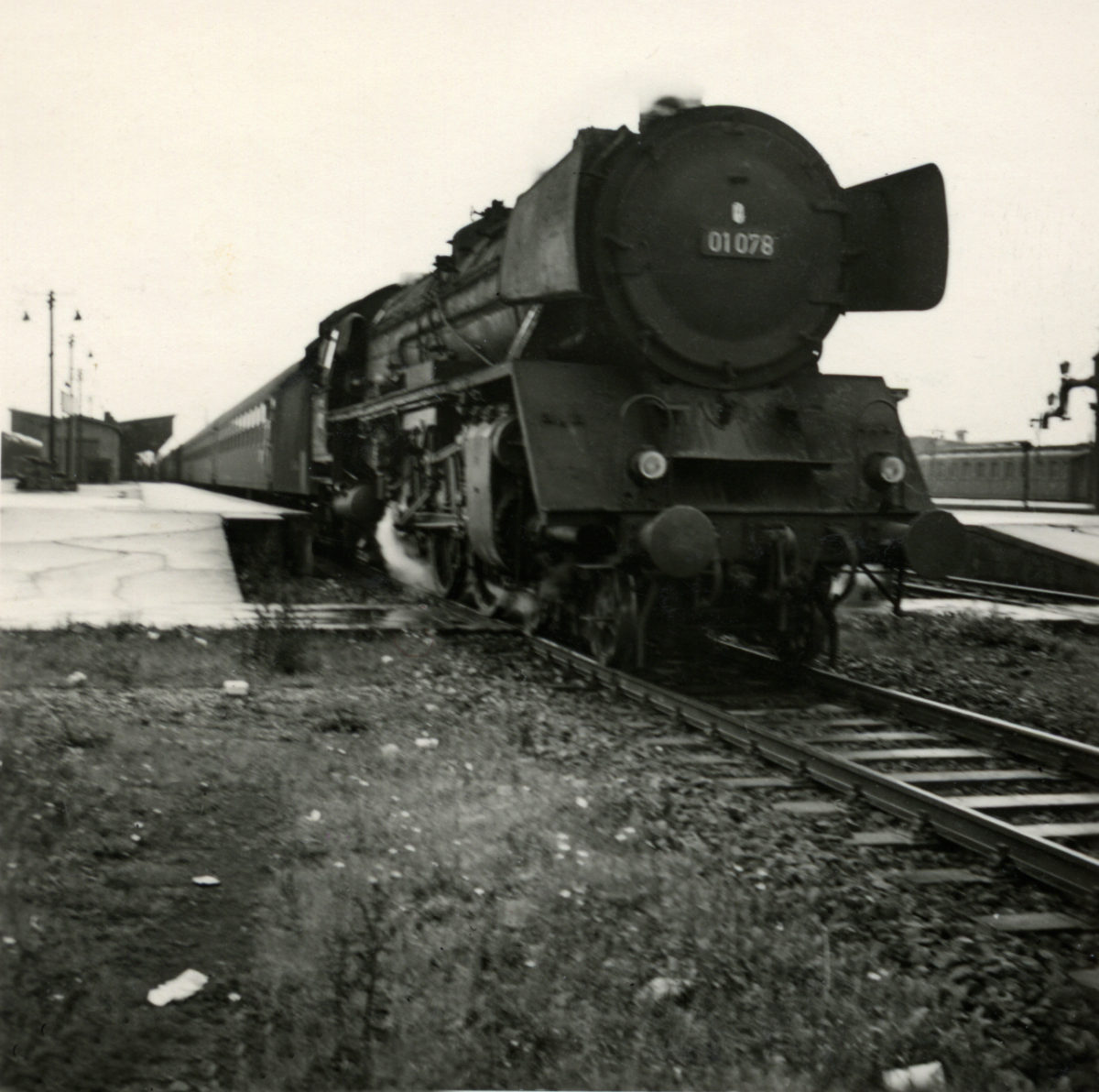
Manfred also asked the driver of an express if I could sample a ride, and I travelled into Hamm on the footplate. The Germans, as ever, were proud to demonstrate the capabilities of their locomotive which I was told had a speedometer – unlike (?) an English engine, and which showed we were travelling at speeds of nearly 100 kph. The feature that struck me most forcibly was the sway of the engine itself as the connecting rods pulsated on each side. I was able to travel back to Dortmund free, and quite sedately as a passenger in a local train.
After living in the garrison for several months, it was decided that we would all be better off billetted with the local Sapper Regiment – 23 Field Engineer Regiment. They were quartered in the Luftwaffe camp; a very comfortable place; where the lofty officers mess dining room had a musicians gallery at one end.
I there met the second murderer of my acquaintance, a first lieutenant, Peter Poole. He was originally from Essex and had served in the African Police before joining the army. He was almost universally unpopular for his abrupt and arrogant manner; he was the butt of any spiteful horseplay on mess nights. Some time after I left the army, a man of the same name was accused in Africa of murdering his house boy who had been taunting his dog, and who turned out to be the same person. Peter Poole was tried, found guilty and sentenced to death. Peter, however, knew that his offence did not warrant such a reward, and was completely confident that the Queen would grant him a reprieve. Unfortunately for him, the wind of change was blowing in Africa, and the colony was emerging as an independent state. Peter Poole was duly hanged.
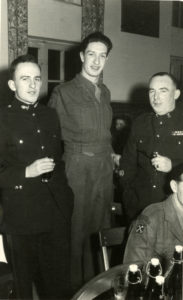
I met a Sapper officer many years later at a City of London lunch. We got talking, and I recognised his name – a major, subsequently colonel, Perkins. I asked him if he had known Peter Poole, and I was curtly informed that Peter had been in his squadron, and had been a good friend of his and of his wife…
I was able to visit the local tourist sights, which included the picturesque Rhine valley and the Eiffel forest. I went to a pony trotting event and with another R.E. lieutenant to sail across the Möhne dam. Unfortunately during this last outing, my companion wound up the centreboard of the army dinghy so vigorously that it somersaulted out of the bottom of the boat, and disappeared. Luckily, the loss was overlooked.
In the summer of 1956, 28 Field Engineering regiment staged a ball. This was a spectacular affair – it lasted throughout the night and finished with a generous breakfast.