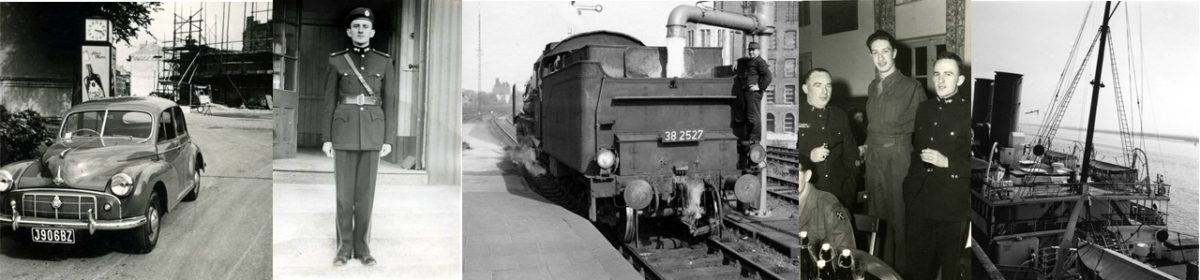
Germany in the nineteen fifties was being quickly reconstructed, unlike London, which was still awaiting repair. Although cities like Köln were still devastated, much was underway elsewhere. Unlike England, where food rationing was still a recent memory, eating out was a real treat, particularly the delicious fruit tortes and cream. With very few exceptions, the people were courteous and welcoming, possibly influenced by the proximity of their communist neighbours. Few soldiers spoke, or tried to learn the language, which did not really matter, as they led a different life and rarely mixed with the local population. It was a recognized jest that a biϊstenhalter was thought to be a bus stop, not a bra… Certain privileges were still available to the occupying forces; fuel concessions, and within garrisons, drink and tobacco were much cheaper. Many pre war cars were still in use, particularly two stroke D.K.W.s with fabric covered outer panels. When a V.W. full of drunken Belgians collided with a municipal tram with all the cars’ passengers dying in the ensuing conflagration, the wreckage was displayed in the town centre with a large board above warning of the perils of drinking and driving. Consumer goods were plentiful and varied, unlike in England.
I was sent to Mönchengladbach, a medium sized town near the larger new military base of Rheindahlen. When I reached my new post I asked what I was expected to do. “Don’t worry, you will be sent on a course at Longmoor in Hampshire,” I was told. Unsurprisingly I was never sent there, and I am still not sure what they would have told me to do h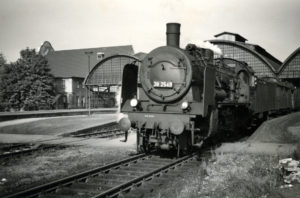 ad I done so.
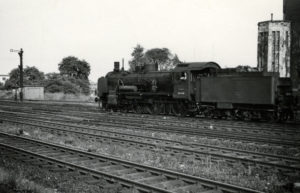
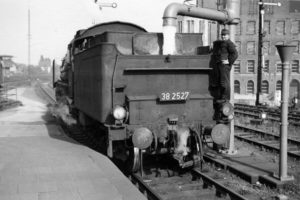
My new commanding officer was Ben Reeve, a captain in the Suffolk Regiment. He lived in married quarters with his wife, Vera, a forces school teacher. Our offices were part of the Hauptbahnhof (railway station) complex, warm and comfortable. The staff comprised Ben, Sergeant Major Sallows, Sergeant Eglington, Sergeant Snell, Corporal Clarke, two Sappers, several displaced persons who handled baggage, a number of German staff who acted as interpreters and did all the administrative work, and a German driver. Among the civilian staff were whose English language skills were particularly good; Jim Hank and Harry Roten. Jim was the archetypal German, if not Prussian; erect, slightly stout, with short cropped hair, a cigar smoker. Harry was a young man who modelled himself on looking English, while wearing what he felt were English clothes (a bright blue woolen jacket, pale grey cotton trousers, and grey leather shoes). Jim had a slightly cockney twang, Harry, virtually no accent. I once asked how Jim’s English was so good; in spite of his obviously German background, he was in fact English, having been a staff sergeant in World War 1, who stayed on in Germany and married a German girl. He worked at the Ford factory in Köln during the Second World War. Harry’s English was almost accentless, and he always asked us to put him right if he mispronounced any words. He rarely did, however, and this was really the reason one would not think he was English – he had no regional accent. We had an army Volkswagen beetle: dark green with a folding roof, crash gearbox and cable brakes.
The workload was minimal. We had two military (steam) trains each day; one in the morning from the Hook of Holland, and one returning later, from Hannover. We had to see military and some civilian staff on and off these two trains, and occasionally we had to go to another station or depot to hand over paperwork for, perhaps, a consignment of tanks. We also had, once a week or so, trains to and from Klagenfurt, known as the Medloc express – Mediterranean lines of communication. At one time this had carried a slip coach which would be dropped at Mönchengladbach and then reattached to the Hannover train for onward re-routing to Berlin. Sergeant Eglington was said to have somehow contrived matters so that the Medloc coach was sent back to Austria where it had originated instead of Berlin, and attached the slip coach for Berlin to the Hook of Holland train.
As we were based at the nearest main railway station to the Rhinedalen headquarters, we had our fair share of VIP staff travelling through. Very often they would travel back on the evening civilian express, and frequently with their wives. It was not unusual to have to escort an elderly retired staff officer and his consort, find them their reserved seats, put their baggage on the rack, salute and say farewell. As the train only stopped for two minutes, it was usually travelling between five and ten miles an hour by the time we baled out, our studded boots skating along the platform
Mönchengladbach was a good posting; the actual mess was a large corner dwelling near the opera house, and our sleeping quarters were a short distance away in the the same road. The soldiery lived comfortably nearby. Those using the mess were from a variety of corps and regiments; the president was from the Royal Army Service Corps and there were officers from REME, a cavalry regiment, signals, sappers and others. The waitresses who looked after us were upmarket German ladies, and my batman was a middle aged German.
My first (monthly) mess dinner evening, when everyone wore ceremonial dress uniform, or “blues” ended disastrously. The second lieutenants from R.E.M.E. showed me the ropes, and we were treated to a good meal. At the end of it, and after the formalities, which included drinking the Queen’s health, we left the table and moved to the bar. On of my new R.E.M.E. friends then said that he’d had enough and thought he would leave; the other agreed. It seemed a trifle premature to me, but as they were more experienced, I assumed we would not be breaking any rules. Luckily(?) we asked the colonel’s permission first. Colonel Kennedy did not respond as we might have hoped. “Leave?” He asked. “Yessir”, “Why?” He demanded. One of my companions explained that we wished to go to bed. This proved to be the blunder of the evening. “Not only will you not be allowed to leave now, but I will personally ensure that you three will be the last to leave tonight.” End of story!
We could pay sixpence (old money!) to travel to the cinema by the garrison VW personnel carrier; at headquarters in Rhinedalen where there was an army and an RAF cinema.
Drink was cheap: threepence old money for a single measure of spirits, and cigarettes were only eleven pence for twenty or a shilling for Players Perfectos – the ultimate smoke. Düsseldorf, Köln, and the Eiffel mountains were nearby. My CO’s wife introduced me to a young teacher friend, Joan Dawson, and life was very comfortable, improved further by the use of my car, a Morris Minor, which I brought over on the Dover to Calais ferry, and which facilitated viewing the locality.
We explored Düsseldorf night life with the help of a duplicated copy of “Bon Viveurs Alternative Guide.” We (the R.E.M.E. subalterns and I) were set on viewing a totally naked artiste, but disappointingly all we saw were ageing topless dancers, and drank expensive, poor quality, fizzy white wine. We went in Graham’s elderly Opel which had a front wheel tyre burst on the return early morning journey, luckily without any consequent problems. Graham worked at the local Rhine army workshops, where they reconditioned elderly half track vehicles. They told me the majority of repaired trucks failed before they had covered a thousand miles.
Suddenly everything changed. I received a letter from England which reminded me why I was where I was when I was. Ann had written asking after me. She did not know I was in the army and in Germany. I replied cautiously – she said insensitively – saying that I would be pleased to meet her in Düsseldorf any time she happened to be there. I did not want to sound too eager and to find that matters had not really changed.
However the next letter I received told me that she had borrowed a hundred pounds from her mother and was indeed coming to Düsseldorf as soon as it was convenient.
I arranged with Vera Reeve to put her up, and with Ben for me to take time off to show her around.
I met Ann off a Dakota of the British European Airways flight. We went to Köln for a day’s outing, climbed the southwestern cathedral tower, I proposed and – luckily – was accepted. We visited a jewellers in the devastated city, and bought a ring. We returned home to Mönchengladbach way of Monschau in the Eiffel Mountains and spread the glad news. Mother and father were shocked: they thought a long engagement would be sensible. Ann did not agree, and nor did I, for I didn’t want her to have the opportunity of a further change of heart. We eventually settled for just under a year; effectively, as soon as I was demobilised. Reports upon the arrival of my letter announcing my betrothal varied – one of my brothers said father was enthusiastic, but both agreed that my poor mother was distraught (wait and see, she’ll do it again!).