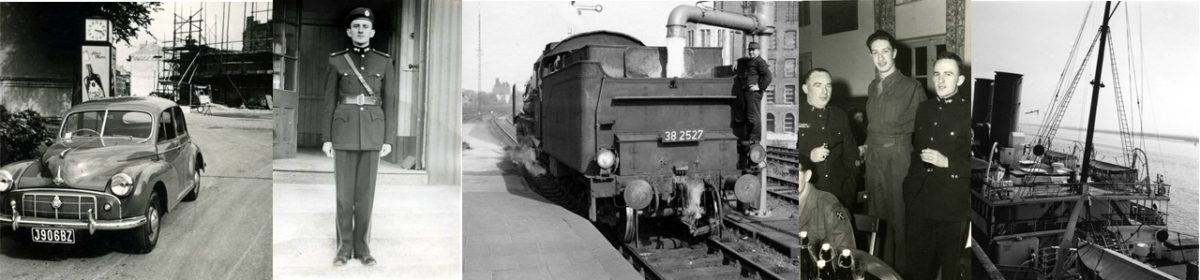
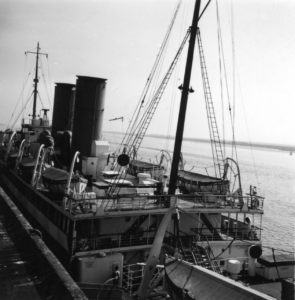
The Suez crisis erupted. Reservists were sent out from England to retrain in Germany, and Movement Control staff were sent down to the Hook of Holland to help handle the extra traffic. The two troop ferries; the Vienna, a converted civilian ship, and The Empire Wansbeck, which I believe had been a minesweeper, did double trips, and an extra tho
usand or so troops arrived each day in the early evening. The usual boat arrived every morning and the RTO staff ate breakfast in the mess before seeing the trains filled. They then ate a second meal on the train. They were served by the ‘wagon lits’ staff; the food was no problem to eat, as we all had risen early, and had usually completed our day’s’ work by nine or ten in the morning.
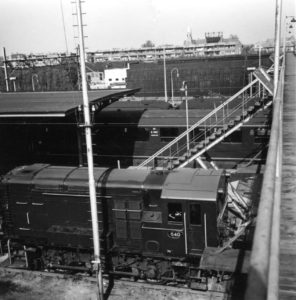
The Hook was comfortable; we lived in Nissen Huts and except when the troops were actually moving through – breakfasts for a hundred or a thousand, depending upon North Sea weather – we were chiefly left to our own devices. We visited Rotterdam, Scheveningen, The Hague and areas of Holland, made easier for me by having the use of a car.
To transport the reservists into Germany, additional daytime ferry sailings were arranged and supplementary military trains run to deal with the extra numbers.
The soldiers themselves were poorly disciplined. There was not much enthusiasm for the Suez adventure, and many of the troops were in the logistical branches rather than front line soldiers. They came ashore in the warm August weather wearing their battledress blouses, but unbuttoned, and with their berets tucked under their epaulettes. Their non-commissioned officers were disenchanted with their return to the military environment that most of them thought they had put behind them when they had been demobilised. I do not remember how the officers appeared, but the overall impression was of an unwilling and unhappy group of conscripts. Unlike recruits coming in for the first time, they had seen it all before, and resented this attempt to recall them. The regular army warrant officers however, had no trouble in handling them.
One evening, the first train came into the platform early. Sergeant Major Webb jumped off and came down the platform.
“Evening, Mr Fuller – what time do I go back?”
“Nine o’clock, Mr Webb.”
“I’ll just go down to the NAAFI, and have a cup of tea.” Mr Webb disappeared
The second train came in a few minutes later, Sergeant Major Bird came down the adjacent platform toward me.
“What time does the train leave, Mr Fuller?”
“Nine o’clock, Mr Bird.”
Mr Bird followed Mr Webb to the NAAFI. Unaccountably, although I knew the first train left at eight forty five, I had given both men the time of the second departure, with results that would shortly become all too apparent.
The reservists now trailed onto the platform. Although soldiers were never marched up to the train, these men somehow managed to make the whole operation informal to the point of indiscipline. They were commanded by their own NCOs and officers, and their behaviour among themselves was no concern of mine, but I was thankful that there was a regular army warrant officer commanding the train.
The Dutch railway official came up to me when everyone was embarked and asked if everything was ready for departure. I confirmed that it was, whistles were blown and the train load of what I privately thought of as a football type hooligans slowly moved away.
Just as the tail lamps of the last coach disappeared from view, Mr Webb came panting up the platform. This time he didn’t even waste time on a perfunctory salute.
“What time did you tell me my train was leaving, Sir?”
A nasty moment. However, it was clearly my fault, so I might as well admit it straight away.
“I told you nine o’clock, Mr Webb, but I should have told you eight forty five.”
“What should I do now, Sir?”
This was a real poser, but there seemed to be only one practicable solution.
“Don’t worry, I will have the train stopped.”
I could clearly see the result of leaving a trainload of reservist vandals careering across Holland and Germany with no responsible person in charge. My imagination drew a picture of a train with all the fittings loosened – perhaps thrown out of the windows. The reservist officers and NCOs would have no chance against this band of potential mutineers. The guard even less so. I would be the person ultimately responsible for this disaster which would reflect upon my Corps, the British Army, England…
I hastily found the stationmaster and explained what I wished him to do. He did not seem wholly enthusiastic about my proposal, but agreed to arrange to have the train halted.
Unfortunately this proved to be rather less easy than I might of imagined. To just stop a train that has had its path arranged all the way to Hanover is not like stopping a bus and asking the driver to hang on for a few minutes as the conductor has been left behind.
They did indeed manage to stop the train; by the time a suitable place had been found, it had reached the Dutch border about an hour away from the Hook. The stationmaster approached me with a blank expression on his face, and asked me what I would like to do next.
I explained that I would send the sergeant major to catch the halted train. I arranged for Mr Webb to be taken out in one of the garrison Volkswagens, and when the driver returned about midnight, he told me that Mr Webb had caught the train, which as far as he could tell, was still in one piece.
I was pleased at this successful outcome of my rescue plan. With no help other than the resources I had called upon, I had avoided a mutiny and saved the day. If one overlooked the fact that the whole problem had been caused by my own incompetence, the way it was dealt with showed a flair for prompt decision and supporting action.
I did not ever consider it necessary to make a formal report about the evening’s events to my superior officers. In the light of subsequent events this might have been considered less than prudent.
Ten days later I was given a message to report to Major Butler, my commanding officer.
I had no premonition of any problem; and when I entered Major Butler’s office, he was, as ever, courteous and pleasant.
“Good morning Fuller, I expect you know why I have asked you to come and see me?”
I had no idea at all. My escapade with the halted train was past history, and I had managed to put it out of my mind. The second train had left on time, and if I thought about it at all, which I doubt I did, I would have considered the whole event nothing more than a slight administrative hiccup.
“The Dutch Railway authorities have reported that a military train was delayed at the Dutch Border for nearly two hours the other night on your instructions; can you explain to me what happened?”
My stomach felt as if someone had just punched it. However, the facts were straightforward enough, so all I had to do was explain what I had done.
“Well, Sir. There were two trains returning to Germany that evening, and for no reason other than my own stupidity, I told both TCWOs that their trains left at nine o’clock, when in fact one left fifteen minutes earlier. As a result, the first train left without anyone in charge, and I felt the best course of action would be to stop it and send the sergeant major out to catch it. Dutch Railways were unable to stop it any earlier, but I had hoped that my actions would be the best solution to the problem.”
Major Butler rubbed his chin.
“I appreciate your frankness Fuller, but the War Office have received a bill for £600 from the Dutch Railways, and I think we will have to think of a rather better excuse than the one you have given me. You may go.”
I went. I never found out what his story was, but the bill was never passed on to me, for which I was truly thankful, representing as it did nearly three years pay!
When the time came for my demobilisation, I had to return by the civilian ferry from Calais. I asked Major Butler what formalities I had to undergo, and he said “Just leave”. I could hardly believe it could be so simple, but as it was an order, I left.
I was due to be married in two weeks time, and when I reached home everyone was busying themselves for the forthcoming event, which was to be in Cheshire, which for my family was as remote as the Trossachs.
On the Thursday after my return, I had a message to contact the War Office. When I returned the call and gave my name, I was told that I had orders to report to Longmoor Camp the following Monday. “But I am due to be married in two weeks time!” “Can’t help that, the orders are clear and confirmation is in the post.” I assumed that the problem was yet another consequence of the Suez upheaval, but my whole family went into panic mode, as may be imagined. Luckily I had a solicitor uncle, who had a contact at the War Office who was persuaded to look into the matter. The result was that a lieutenant Fuller had indeed been given a posting to Longmoor, but that this lieutenant H. Fuller, had omitted to surrender his army paybook before leaving Holland. And would he please send it on to the appropriate War Office department?
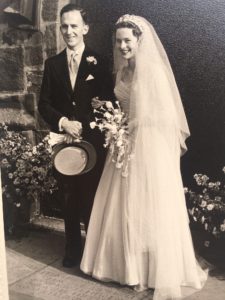
I was married on the 13th October, and life changed once more as Ann and I set up house in Walthamstow in East London. I returned to work for my old employers, commuting into Stratford each day, and returning to attend classes several evenings of the week in order to complete my unfinished exams. My paternal uncle, who ran half the family building business, became a widower at the end of the year, and decided to retire; my cousin and I then joined the company, and continued to work for it for some forty years. Ann and I were fortunate in having five children. The business (generally) prospered and survived until the late nineteen hundreds, when my cousin and business partner decided to retire.